Best Circular Saws for Contractors in 2026
The circular saw is the first tool off the truck on most jobsites. For framing, decking, and rough carpentry, a cordless 7-1/4” circular saw has largely replaced corded models — the battery platforms from DeWalt, Milwaukee, Makita, and Bosch now deliver enough power to cut 2x lumber and sheet goods without a generator or extension cord. This guide compares five cordless 7-1/4” circular saws based on manufacturer specifications, covering the $150-$350 range where most professional-grade models land.
Why 7-1/4 Inch Cordless
The 7-1/4” blade is the contractor standard for reasons rooted in cut geometry:
- Cut depth at 90 degrees: 2-7/16” to 2-9/16” depending on model — enough to cut through a 2x board (actual thickness 1-1/2”) in a single pass with margin to spare
- Cut depth at 45 degrees: Typically 1-3/4” to 1-15/16”, covering beveled cuts on dimensional lumber
- Blade availability: 7-1/4” is the most common circular saw blade size. Framing blades, plywood blades, and specialty blades are available from every manufacturer at every hardware store
- Cordless viability: Modern 18V-60V battery platforms deliver the sustained amperage needed to push a 7-1/4” blade through framing lumber without bogging down. Per manufacturer data, the top cordless models now match or approach the cut speed of 15-amp corded saws
Smaller 6-1/2” saws are lighter but sacrifice cut depth. Larger 8-1/4” and 10-1/4” worm drive saws exist for specialty beam cutting but are too heavy and expensive for general framing.
Blade-Left vs. Blade-Right: Why It Matters
Circular saws come in two fundamental configurations, and the distinction matters more than most spec sheets suggest:
Blade-right (sidewinder): The blade sits to the right of the motor. This is the traditional American sidewinder layout. When a right-handed user cuts along a line, the blade is on the far side of the motor housing, which can obscure the cut line. Blade-right saws are typically lighter and more compact.
Blade-left (worm drive style): The blade sits to the left of the motor. This places the blade on the operator’s side of the saw when held right-handed, providing a direct line of sight to the cut line and the workpiece edge. Traditional worm drive saws used this layout with a hypoid gear system; modern cordless saws achieve the same blade-left position with direct-drive motors.
For framing work, blade-left is generally preferred by professional framers because it provides better cut line visibility when the operator stands to the left of the cut (the standard right-handed framing position). According to industry convention, most worm drive and rear-handle circular saws use a blade-left configuration, while most inline sidewinders use blade-right.
The DeWalt DCS578B and Milwaukee 2732-20 in this comparison use the blade-left, rear-handle configuration that mirrors a traditional worm drive. The Makita XSH06Z and DeWalt DCS570B use blade-right inline designs. The Bosch GKS18V-26GCB14 uses a blade-left inline sidewinder — an uncommon combination.
Top 7-1/4” Cordless Circular Saws
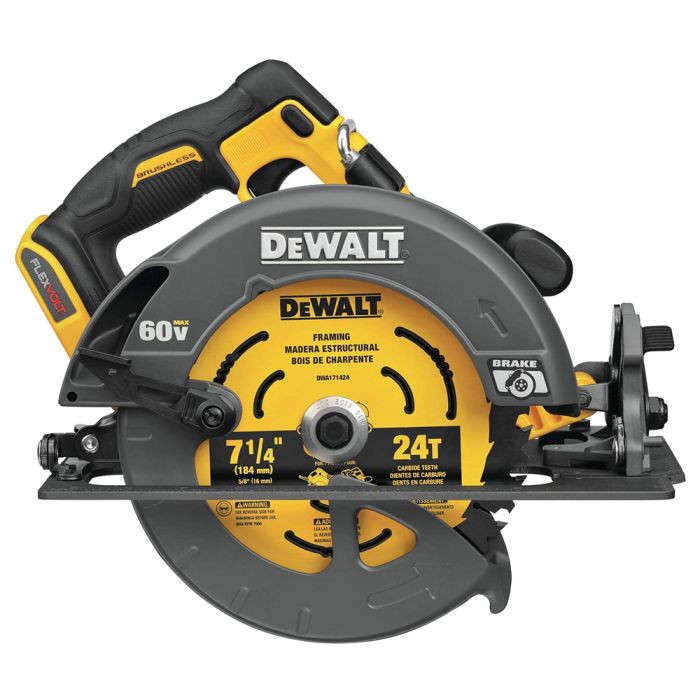
DeWalt DCS578B FLEXVOLT — Best Overall
| Specification | Value |
|---|---|
| Blade Size | 7-1/4” |
| Motor/Battery Platform | Brushless / 60V MAX FLEXVOLT |
| No-Load Speed | 5,800 RPM |
| Cut Depth at 90° | 2-9/16” |
| Cut Depth at 45° | 1-15/16” |
| Bevel Range | 0-57° |
| Blade Side | Left (rear handle) |
| Weight (bare tool) | 7.2 lbs |
| Warranty | 3 years |
| Price Range | $200-$250 (bare tool) |
According to DeWalt’s specifications, the DCS578B uses the FLEXVOLT 60V MAX battery platform — a higher-voltage system that delivers more sustained power under load than standard 20V MAX tools. The rear-handle, blade-left design mimics the ergonomics of a traditional worm drive saw without the weight of a gear-driven motor. Per DeWalt’s data, the 5,800 RPM no-load speed and 60V power source allow it to maintain blade speed through hardwoods and engineered lumber where lower-voltage saws can bog down. The electric brake stops the blade within approximately 2 seconds of trigger release. The 57-degree bevel capacity exceeds the standard 45 degrees, which matters for compound angle cuts on rafters and hip jacks.
Best for: Framers and general contractors who need worm drive ergonomics with cordless convenience. The FLEXVOLT platform’s higher voltage provides measurable power advantages for sustained ripping and cutting dense materials.
Milwaukee 2732-20 M18 FUEL — Best for M18 Users
| Specification | Value |
|---|---|
| Blade Size | 7-1/4” |
| Motor/Battery Platform | Brushless (POWERSTATE) / M18 18V |
| No-Load Speed | 5,800 RPM |
| Cut Depth at 90° | 2-7/16” |
| Cut Depth at 45° | 1-3/4” |
| Bevel Range | 0-53° |
| Blade Side | Left (rear handle) |
| Weight (bare tool) | 7.7 lbs |
| Warranty | 5 years |
| Price Range | $200-$250 (bare tool) |
Per Milwaukee’s documentation, the 2732-20 delivers the same 5,800 RPM as the DeWalt DCS578B but on the 18V M18 platform — no separate battery line required. The rear-handle, blade-left configuration provides the worm drive handling that framers expect. Milwaukee’s REDLINK PLUS electronics protect against overload, overheating, and over-discharge. The stainless steel shoe resists bending from jobsite impacts. According to Milwaukee’s specifications, the rafter hook is integrated (not an add-on) and positions the saw for convenient one-handed hanging between cuts. The 5-year tool warranty is the longest in this comparison and reflects Milwaukee’s positioning in the professional trades.
Best for: Contractors already invested in the M18 ecosystem who want a rear-handle circular saw without buying into a second battery platform. The 200+ M18 tools share batteries, which simplifies fleet management for crews.
Makita XSH06Z 36V (18Vx2) — Best Runtime
| Specification | Value |
|---|---|
| Blade Size | 7-1/4” |
| Motor/Battery Platform | Brushless / 36V (two 18V LXT batteries) |
| No-Load Speed | 5,100 RPM |
| Cut Depth at 90° | 2-9/16” |
| Cut Depth at 45° | 1-7/8” |
| Bevel Range | 0-53° |
| Blade Side | Right (inline) |
| Weight (bare tool) | 7.4 lbs |
| Warranty | 3 years |
| Price Range | $180-$230 (bare tool) |
According to Makita’s specifications, the XSH06Z uses two 18V LXT batteries simultaneously for 36V total output — achieving higher voltage without requiring a dedicated high-voltage battery platform. This dual-battery approach has a practical advantage: contractors already carrying 18V Makita batteries for drills, impact drivers, and other tools can power the circular saw from the same pool. Per Makita’s data, the Auto-Speed Change technology adjusts cutting speed and torque under load to maintain performance and extend battery life. The lower 5,100 RPM no-load speed compared to the 5,800 RPM DeWalt and Milwaukee models is a design choice — Makita optimizes for sustained cutting speed under load rather than peak unloaded RPM. The built-in dust blower clears the cut line without an external dust port.
Best for: Contractors running the Makita 18V LXT ecosystem who do not want to invest in a separate high-voltage battery line. The dual-battery configuration also provides extended runtime compared to single-battery saws.
DeWalt DCS570B 20V MAX — Best Lightweight Option
| Specification | Value |
|---|---|
| Blade Size | 7-1/4” |
| Motor/Battery Platform | Brushless / 20V MAX |
| No-Load Speed | 5,500 RPM |
| Cut Depth at 90° | 2-9/16” |
| Cut Depth at 45° | 1-3/4” |
| Bevel Range | 0-57° |
| Blade Side | Right (inline) |
| Weight (bare tool) | 6.0 lbs |
| Warranty | 3 years |
| Price Range | $150-$190 (bare tool) |
Per DeWalt’s documentation, the DCS570B is the lightest full-size 7-1/4” cordless circular saw in this comparison at 6.0 lbs bare. It uses the standard 20V MAX battery platform rather than the FLEXVOLT system, which means it works with the same batteries as DeWalt drills, impact drivers, and other 20V tools. The tradeoff is straightforward: less sustained power under load compared to the 60V DCS578B, but meaningfully less weight and full compatibility with the most common DeWalt battery line. The 5,500 RPM no-load speed is adequate for dimensional lumber and sheet goods. According to DeWalt’s specifications, the bevel range extends to 57 degrees — matching the higher-end DCS578B — with bevel detents at 22.5 and 45 degrees. The magnesium shoe provides rigidity without added weight.
Best for: Remodelers and trim carpenters who prioritize weight and portability over maximum cutting power. Ideal as a secondary saw for tasks that do not demand sustained ripping through engineered beams.
Bosch GKS18V-26GCB14 PROFACTOR — Best Precision
| Specification | Value |
|---|---|
| Blade Size | 7-1/4” |
| Motor/Battery Platform | Brushless (BITURBO) / 18V CORE |
| No-Load Speed | 5,500 RPM |
| Cut Depth at 90° | 2-7/16” |
| Cut Depth at 45° | 1-13/16” |
| Bevel Range | 0-56° |
| Blade Side | Left (inline) |
| Weight (bare tool) | 7.8 lbs |
| Warranty | 3 years |
| Price Range | $250-$350 (bare tool) |
According to Bosch’s specifications, the GKS18V-26GCB14 uses the PROFACTOR BITURBO brushless motor for maximum power extraction from an 18V battery. The blade-left inline configuration is uncommon — most inline sidewinders place the blade on the right. This left-side blade position gives the operator cut line visibility advantages similar to a rear-handle saw but in the lighter, more compact inline form factor. Per Bosch’s documentation, the Bluetooth-connected module allows tracking tool location and adjusting settings via the Bosch Toolbox app. The saw includes KickBack Control, which uses an accelerometer to detect sudden binding and shuts the motor down within milliseconds. At $250-$350, the Bosch is the most expensive option in this comparison, with a smaller ecosystem (75+ tools) than competing platforms.
Best for: Contractors who prioritize precision features and safety electronics. The blade-left inline design is worth evaluating for users who prefer the sidewinder form factor but want blade-side visibility.
Comparison Summary
| Model | Platform | RPM | Cut Depth 90° | Blade Side | Weight | Warranty | Price |
|---|---|---|---|---|---|---|---|
| DeWalt DCS578B | 60V MAX | 5,800 | 2-9/16” | Left (rear) | 7.2 lbs | 3 years | $200-$250 |
| Milwaukee 2732-20 | M18 18V | 5,800 | 2-7/16” | Left (rear) | 7.7 lbs | 5 years | $200-$250 |
| Makita XSH06Z | 36V (18Vx2) | 5,100 | 2-9/16” | Right (inline) | 7.4 lbs | 3 years | $180-$230 |
| DeWalt DCS570B | 20V MAX | 5,500 | 2-9/16” | Right (inline) | 6.0 lbs | 3 years | $150-$190 |
| Bosch GKS18V-26GCB14 | 18V CORE | 5,500 | 2-7/16” | Left (inline) | 7.8 lbs | 3 years | $250-$350 |
Battery Platform Considerations
The circular saw draws more sustained current than drills or impact drivers, which makes battery platform choice more consequential:
- DeWalt FLEXVOLT 60V MAX: Purpose-built for high-draw tools. The FLEXVOLT batteries also work in 20V MAX tools, but 20V MAX batteries cannot power 60V tools. This creates a one-way compatibility that is worth understanding before buying in
- Milwaukee M18 HIGH OUTPUT: Milwaukee addresses the high-draw problem with higher-capacity M18 batteries (6.0 Ah, 8.0 Ah, 12.0 Ah HIGH OUTPUT packs) rather than a separate voltage platform. Per Milwaukee’s data, an 8.0 Ah HIGH OUTPUT battery is recommended for the 2732-20
- Makita 18Vx2: The dual-battery approach avoids a separate platform entirely but requires two batteries per tool. For crews with deep 18V inventory, this is efficient; for buyers starting fresh, the doubled battery requirement adds cost
- Bosch CORE18V: The smallest ecosystem of the four. Competitive individual tools, but contractors building a full kit may find coverage gaps in specialty categories
Blade Selection
The included blade on most circular saws is a general-purpose 24-tooth framing blade. According to blade manufacturer specifications, optimizing blade choice by task improves both cut quality and blade life:
- Framing (24T): Aggressive tooth geometry for fast cuts in dimensional lumber. Prioritizes speed over finish quality
- Plywood/sheet goods (40-60T): More teeth produce cleaner edges with less splintering on veneered surfaces
- Decking/composite (specialty): Non-stick coatings and modified tooth geometry prevent resin buildup when cutting composite decking materials
- Demolition (carbide-tipped): Designed to survive occasional nail hits. Not precision blades, but they avoid the cost of ruining a finish blade on hidden fasteners
A quality 7-1/4” framing blade costs $8-$15. Keeping two or three task-specific blades on the truck avoids the temptation to use one blade for everything — a common source of poor cuts and premature blade replacement.
Pairing with Other Jobsite Tools
The circular saw handles straight cuts, but most jobsites require a broader cutting setup:
- Miter saw: For repetitive crosscuts at precise angles — trim, framing, and stair stringers. See the best miter saws for contractors for a detailed comparison
- Cordless drill: Every saw cut requires measurement, and most framing tasks alternate between cutting and fastening. A matched battery platform between the circular saw and cordless drill eliminates the need for separate chargers and battery inventory
Staying within one battery platform across circular saw, miter saw, drill, and impact driver is the most practical approach for managing a cordless jobsite. The battery ecosystem decision — not any individual tool specification — is the highest-leverage choice a contractor makes.
Who This Is NOT For
- Occasional weekend projects. A corded 7-1/4” circular saw ($50-$80) cuts the same lumber without the $150-$350 tool cost plus $100-$200 in batteries. Cordless convenience is a daily-use justification, not a weekend one
- Precision woodworking. Circular saws are rough-cut tools. For furniture-grade rip cuts, a table saw provides the fence system, dust collection, and repeatability that circular saws cannot match — even with aftermarket guide rails
- Sheet goods only. If the primary task is cutting plywood and OSB, a track saw system provides straighter, cleaner cuts with integrated dust collection. Circular saws can cut sheet goods with a straightedge guide, but it is a workaround rather than a purpose-built solution
- Users without an existing battery platform. Bare tool prices are misleading. A complete setup (saw + two batteries + charger) runs $350-$550. Corded alternatives at $80-$150 deliver equivalent cutting performance without the battery investment — the tradeoff is cord management and generator dependency on sites without power
Sources
- DeWalt DCS578B FLEXVOLT specifications (dewalt.com)
- DeWalt DCS570B 20V MAX specifications (dewalt.com)
- Milwaukee 2732-20 M18 FUEL specifications (milwaukeetool.com)
- Makita XSH06Z 36V product documentation (makitatools.com)
- Bosch GKS18V-26GCB14 PROFACTOR specifications (boschtools.com)
- OSHA circular saw safety standards (29 CFR 1926.304)