Best Cordless Drills in 2026
The cordless drill is the most-used tool in any contractor’s kit. The top-tier models from Milwaukee, DeWalt, and Makita have converged to similar specifications on paper — the real differences show up in ergonomics, battery ecosystem depth, and long-term durability under daily professional use.
This guide compares flagship 18V/20V brushless cordless drills. (Note: DeWalt’s “20V MAX” is the same nominal 18V architecture — the 20V figure is unloaded voltage per ANSI standards. All brands in this comparison use 18V nominal battery platforms.)
What Matters in a Professional Cordless Drill
Based on manufacturer specifications and industry standards:
- Brushless motor: Longer life, more power, better efficiency. All flagship models are brushless — avoid brushed motors for professional use
- Torque output: Measured in inch-pounds (in-lbs). 1,200+ in-lbs handles most drilling and driving tasks
- Chuck type: 1/2” all-metal ratcheting chuck is the professional standard. Keyless with auto-lock preferred
- Speed settings: Two-speed gearbox (low for driving, high for drilling) is minimum. Three-speed adds a mid-range for self-feeding bits
- Battery platform: The drill matters less than the ecosystem. Choose based on what other cordless tools you need
- Runtime and charge speed: Fast-charging batteries (under 45 minutes for a full charge) reduce downtime. Higher amp-hour (Ah) packs extend runtime but add weight — a 2.0 Ah compact pack suits overhead work while a 5.0 Ah or 6.0 Ah pack is better for sustained drilling
Top Cordless Drills
Milwaukee M18 FUEL 2903-22 — Best Overall
| Specification | Value |
|---|---|
| Voltage | 18V (M18) |
| Motor | Brushless (POWERSTATE) |
| Max Torque | 1,400 in-lbs |
| Speed 1 | 0-550 RPM |
| Speed 2 | 0-2,000 RPM |
| Chuck | 1/2” all-metal ratcheting |
| Weight (bare) | 3.7 lbs |
| Head Length | 6.9” |
| Battery Compatibility | 200+ M18 tools |
| Warranty | 5 years (tool), 3 years (battery) |
| Price Range | $140-$170 (bare tool) |
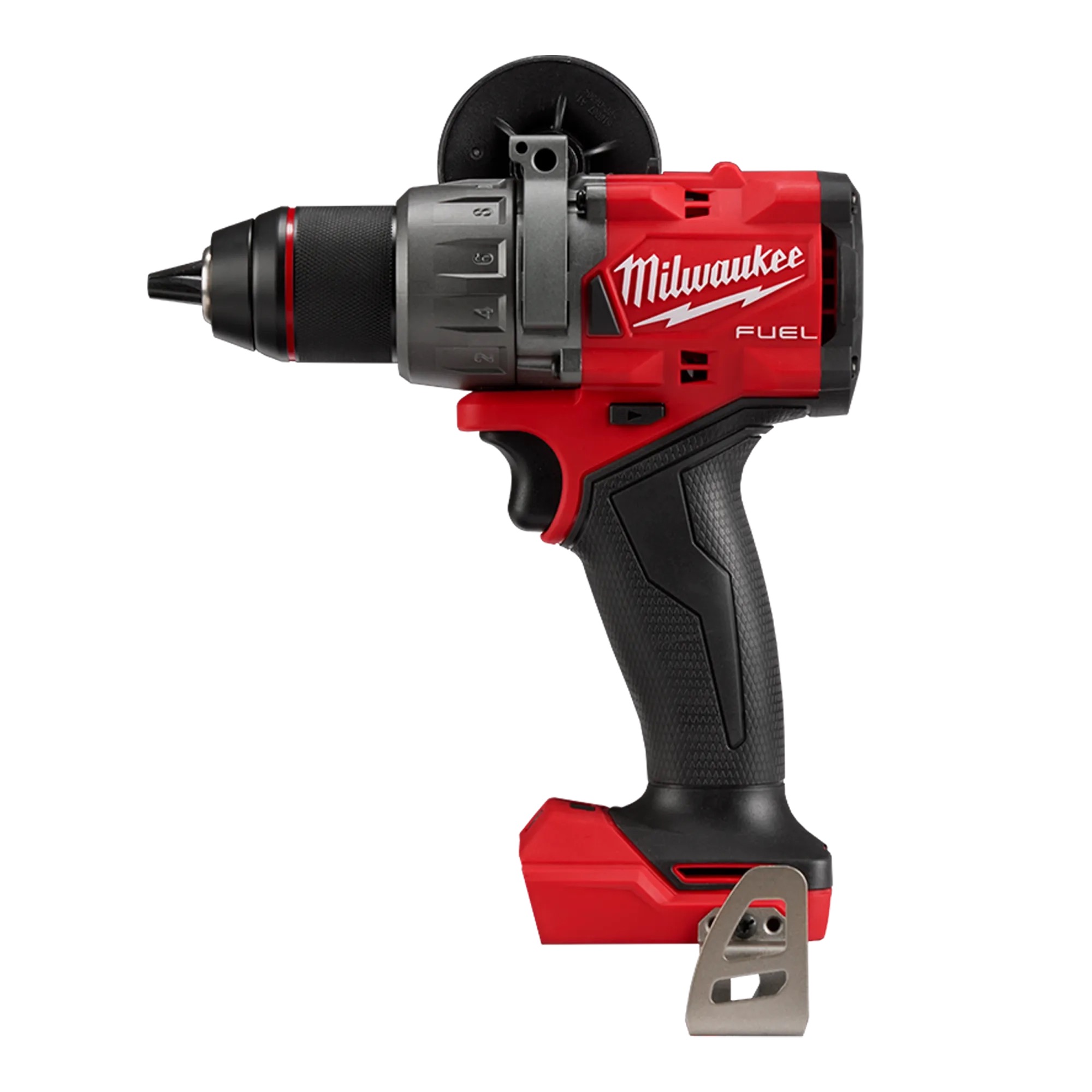
According to Milwaukee’s specifications, the 2903-22 delivers 1,400 in-lbs of torque — the highest in its class. The POWERSTATE brushless motor uses rare-earth magnets for sustained output under load. Milwaukee’s REDLINK PLUS electronics protect against overload, overheating, and over-discharge. The M18 platform now includes over 200 tools, making it the deepest cordless ecosystem available per Milwaukee’s catalog. The all-metal ratcheting chuck resists bit slippage under high-torque loads, a persistent problem with plastic-sleeve chucks on lower-tier drills.
Best for: Contractors building out a full cordless kit. The M18 ecosystem covers everything from drills to concrete tools to lighting, with battery compatibility across the entire line.
DeWalt DCD999B — Best for Heavy Drilling
| Specification | Value |
|---|---|
| Voltage | 20V MAX (18V nominal) |
| Motor | Brushless (FLEXVOLT ADVANTAGE) |
| Max Torque | 1,300 in-lbs |
| Speed 1 | 0-450 RPM |
| Speed 2 | 0-1,300 RPM |
| Speed 3 | 0-2,000 RPM |
| Chuck | 1/2” all-metal ratcheting |
| Weight (bare) | 4.2 lbs |
| Head Length | 7.4” |
| Battery Compatibility | 300+ 20V MAX tools |
| Warranty | 3 years (tool), 3 years (battery) |
| Price Range | $170-$200 (bare tool) |
Per DeWalt’s documentation, the DCD999 uses FLEXVOLT ADVANTAGE technology that draws increased power from FLEXVOLT 60V batteries (while remaining compatible with standard 20V MAX packs). The three-speed transmission provides a mid-range (1,300 RPM) optimized for self-feeding bits and hole saws — tasks where the two-speed models force a compromise between too slow and too fast. At 4.2 lbs, it is the heaviest drill in this comparison, which is the tradeoff for a more robust gearbox and the additional speed range.
Best for: Electricians, plumbers, and HVAC contractors who drill large-diameter holes regularly. The three-speed gearbox and FLEXVOLT compatibility provide measurable advantages for heavy boring work.
Makita XFD14Z — Best Ergonomics
| Specification | Value |
|---|---|
| Voltage | 18V (LXT) |
| Motor | Brushless |
| Max Torque | 1,240 in-lbs |
| Speed 1 | 0-500 RPM |
| Speed 2 | 0-2,100 RPM |
| Chuck | 1/2” all-metal single-sleeve |
| Weight (bare) | 3.3 lbs |
| Head Length | 7.0” |
| Battery Compatibility | 300+ LXT/XGT tools |
| Warranty | 3 years |
| Price Range | $110-$140 (bare tool) |
According to Makita’s specifications, the XFD14Z is the lightest drill in the flagship brushless category at 3.3 lbs bare. The ergonomic handle design uses a shorter head length and optimized center of gravity. Makita’s battery platform spans both 18V LXT and 40V XGT lines, with an adapter allowing cross-compatibility. Per Makita’s data, the electronic clutch provides 21 torque settings plus drill mode for consistent screw depth. The XFD14Z also offers the highest Speed 2 ceiling in this group at 2,100 RPM, which benefits smaller-diameter drill bits that perform better at higher rotational speeds.
Best for: All-day drilling and driving where fatigue matters. The weight advantage adds up over hundreds of screws per day. Strong choice for drywall, deck building, and general carpentry.
Bosch GSR18V-1330CN — Best Electronics
| Specification | Value |
|---|---|
| Voltage | 18V (CORE) |
| Motor | Brushless (EC) |
| Max Torque | 1,330 in-lbs |
| Speed 1 | 0-500 RPM |
| Speed 2 | 0-2,100 RPM |
| Chuck | 1/2” all-metal |
| Weight (bare) | 3.5 lbs |
| Head Length | 7.1” |
| Battery Compatibility | 75+ 18V tools |
| Warranty | 3 years |
| Price Range | $150-$180 (bare tool) |
Per Bosch’s documentation, the GSR18V-1330CN features Bluetooth connectivity to the Bosch Toolbox app, allowing users to customize torque settings, speed limits, and LED behavior. The KickBack Control uses an inertial sensor to detect binding events and shuts down the motor in milliseconds — a safety feature for large-diameter hole saws and auger bits. The smaller 18V ecosystem (75+ tools vs. 200-300+ for competitors) is a real limitation for contractors who want a single battery platform across every tool category.
Best for: Tech-forward contractors who value electronic customization. The KickBack Control is a genuine safety advantage for boring work in hard materials.
Comparison Summary
| Model | Torque | Weight | Head Length | Speeds | Ecosystem | Price |
|---|---|---|---|---|---|---|
| Milwaukee 2903-22 | 1,400 in-lbs | 3.7 lbs | 6.9” | 2 | 200+ tools | $140-$170 |
| DeWalt DCD999B | 1,300 in-lbs | 4.2 lbs | 7.4” | 3 | 300+ tools | $170-$200 |
| Makita XFD14Z | 1,240 in-lbs | 3.3 lbs | 7.0” | 2 | 300+ tools | $110-$140 |
| Bosch GSR18V-1330CN | 1,330 in-lbs | 3.5 lbs | 7.1” | 2 | 75+ tools | $150-$180 |
The Battery Platform Decision
The drill itself is a $100-$200 decision. The battery platform is a $2,000-$10,000 decision over the life of a professional kit. Per manufacturer catalogs:
- Milwaukee M18: Deepest selection in the professional segment. Dominates in plumbing, electrical, and mechanical trades
- DeWalt 20V MAX: Widest overall catalog including outdoor power and concrete. Strong with general contractors and framing crews
- Makita 18V LXT: Broadest international presence. Strong in woodworking, landscaping, and residential construction
- Bosch 18V: Smallest ecosystem but competitive individual tools. Strongest in European markets
Switching platforms is expensive — batteries, chargers, and tool muscle memory all factor in. Choose the platform that covers your full tool needs, not just the drill that wins on one specification.
Who This Is NOT For
- Occasional home use. A $60-$80 brushed 12V drill handles weekend projects without the cost and weight of an 18V professional tool. The batteries alone on an 18V platform cost more than a complete 12V kit
- Impact driving as the primary task. If 80% of your work is driving screws and fasteners, buy an impact driver first — they’re lighter, more compact, and better suited to high-torque driving than a drill. Most contractors carry both, but if the budget only allows one, let the dominant task decide
- Masonry drilling. Standard drills cannot drill concrete or brick effectively. A hammer drill or rotary hammer is the correct tool for masonry. Some models in this comparison (notably the DeWalt DCD999B) include a hammer drill function, but dedicated rotary hammers outperform combo tools in masonry by a wide margin
- Budget-constrained buyers who do not already own a battery platform. Bare tool prices look reasonable, but the real cost includes batteries ($60-$120 each), a charger ($40-$80), and a carrying case. Kit bundles (tool + 2 batteries + charger) run $200-$350 and represent significantly better value for first-time buyers
Sources
- Milwaukee M18 FUEL 2903-22 specifications (milwaukeetool.com)
- DeWalt DCD999B FLEXVOLT ADVANTAGE specifications (dewalt.com)
- Makita XFD14Z product documentation (makitatools.com)
- Bosch GSR18V-1330CN specifications (boschtools.com)
- ANSI/CTA-2045 battery voltage measurement standards