Best Oscillating Multi-Tools for Contractors in 2026
An oscillating multi-tool is the problem-solver that fills gaps between dedicated power tools. It cuts, sands, scrapes, and grinds in tight spaces where circular saws, reciprocating saws, and rotary tools cannot physically reach. For contractors, that means flush-cutting door casings for flooring transitions, removing old grout, cutting openings in drywall for electrical boxes, trimming shims, scraping adhesive residue, and dozens of other detail tasks that would otherwise require hand tools and significantly more time. The oscillating action — a small-arc side-to-side vibration rather than a spinning motion — makes controlled, precise cuts possible against existing surfaces without damaging adjacent material.
This guide compares five oscillating multi-tools based on manufacturer specifications, covering four cordless models from the major battery platforms and one corded option for contractors who prioritize sustained power over mobility.
Key Specifications Explained
Before comparing individual models, it helps to understand what the numbers on the spec sheet actually mean for jobsite performance.
Oscillation Angle: Measured in degrees, this is how far the blade swings side to side from center. Most professional models fall between 1.4 and 3.2 degrees. A wider angle removes material faster but produces a rougher cut. A narrower angle cuts slower but with more control. According to manufacturer data, the range matters more than the maximum — a tool with 1.4 to 3.2 degrees of adjustable angle covers both precision trimming and aggressive material removal.
Oscillations Per Minute (OPM): The speed of the side-to-side motion. Professional models typically range from 10,000 to 20,000 OPM, with variable speed control. Higher OPM produces faster cuts in wood and drywall. Lower OPM is preferred for metal cutting and sanding, where heat buildup degrades blade life and finish quality.
Blade Interface: This is the most consequential specification for long-term cost of ownership. Two systems dominate the market:
- Starlock / StarlockPlus / StarlockMax: A three-dimensional interface developed by Bosch and Fein. Per Bosch’s documentation, the Starlock system transfers torque more efficiently than flat interfaces, reducing blade slippage under load. StarlockPlus and StarlockMax are backward-compatible and add larger blade mounting surfaces for heavier-duty accessories. Starlock blades snap in and release tool-free.
- Universal fit: An open-blade pattern compatible with most older and current multi-tools. DeWalt, Milwaukee, and Makita use universal-compatible quick-change systems. Blade selection is broader, and third-party blades are cheaper. The tradeoff is less precise blade-to-spindle engagement compared to Starlock.
Battery Platform: Oscillating multi-tools draw less current than circular saws or grinders, so most 18V-20V platforms handle them without issue. The relevant consideration is battery ecosystem — which other tools share the same batteries. For contractors already invested in a platform, staying within it avoids redundant battery inventory.
Top Oscillating Multi-Tools for Contractors
DeWalt DCS356B 20V MAX XR — Best Overall
| Specification | Value |
|---|---|
| Power Source | 20V MAX XR (cordless) |
| Motor | Brushless |
| Oscillation Angle | 1.7 degrees |
| Speed Range | 0-20,000 OPM |
| Blade Interface | Universal quick-change |
| Weight (bare tool) | 3.1 lbs |
| Warranty | 3 years |
| Price Range | $130-$170 (bare tool) |
Check DeWalt DCS356B prices on Amazon
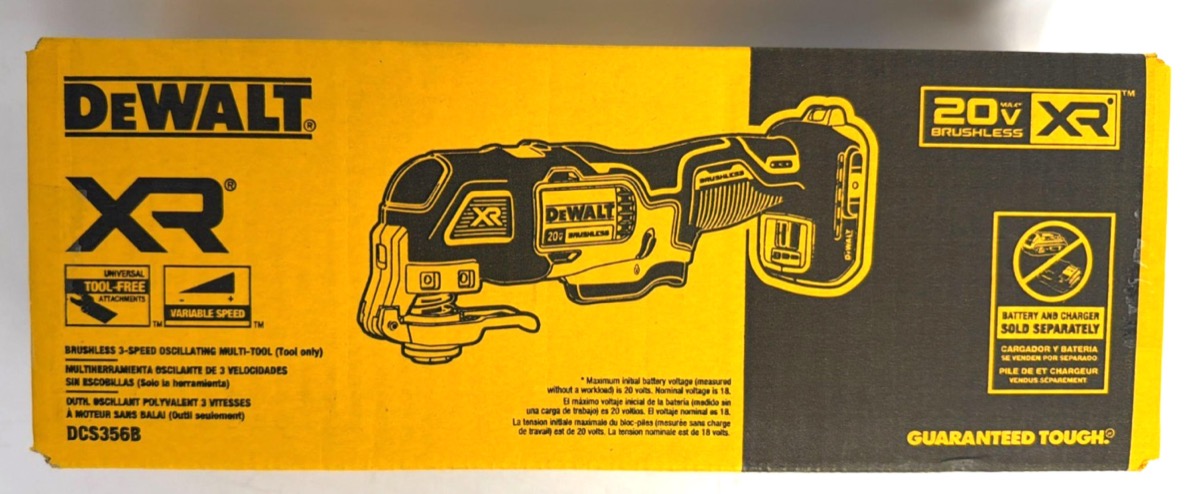
According to DeWalt’s specifications, the DCS356B uses a brushless motor rated at 20,000 OPM with variable speed control via a dial and a variable-speed trigger. The dual-control approach allows the operator to set a maximum speed with the dial and then modulate within that range using trigger pressure — a feature that matters when switching between aggressive wood cuts and controlled metal trimming without stopping to adjust settings. Per DeWalt’s data, the 1.7-degree oscillation angle is fixed, placing this tool in the moderate range that balances cut speed and control. The universal quick-change blade system accepts blades tool-free and is compatible with most aftermarket accessories. The 3.1 lb bare weight keeps one-handed overhead work manageable across a full shift. The 20V MAX platform shares batteries with DeWalt drills, impact drivers, circular saws, and over 300 other tools in the lineup.
Best for: General contractors and remodelers who need a versatile multi-tool across the broadest range of jobsite tasks. The 20V MAX platform compatibility and universal blade interface keep operating costs predictable.
Milwaukee 2526-20 M18 FUEL — Best for Heavy-Duty Cutting
| Specification | Value |
|---|---|
| Power Source | M18 18V (cordless) |
| Motor | Brushless (POWERSTATE) |
| Oscillation Angle | 3.6 degrees |
| Speed Range | 8,000-20,000 OPM |
| Blade Interface | Universal OPEN-LOK |
| Weight (bare tool) | 3.1 lbs |
| Warranty | 5 years |
| Price Range | $170-$210 (bare tool) |
Check Milwaukee 2526-20 prices on Amazon
Per Milwaukee’s documentation, the 2526-20 features the widest oscillation angle in this comparison at 3.6 degrees. According to Milwaukee’s specifications, this wider arc translates to faster material removal — a measurable advantage in demolition-oriented tasks like removing grout, cutting rusted fasteners, or plunge-cutting through subfloor. The OPEN-LOK blade interface is Milwaukee’s proprietary quick-change system; it accepts universal-fit blades and Milwaukee’s own OPEN-LOK accessories, which feature a three-point attachment for reduced blade deflection under load. The variable speed range starts at 8,000 OPM — lower than competitors — giving the operator more usable range when cutting metal or working with heat-sensitive materials. Milwaukee’s 5-year tool warranty is the longest in this comparison. The M18 ecosystem includes over 250 tools, making battery sharing straightforward for crews already on the platform.
Best for: Contractors doing frequent demolition, renovation, and heavy material removal where aggressive cutting speed outweighs precision. The 3.6-degree angle and wide speed range favor power over finesse.
Makita XMT05Z 18V LXT — Best Ergonomics
| Specification | Value |
|---|---|
| Power Source | 18V LXT (cordless) |
| Motor | Brushless |
| Oscillation Angle | 3.2 degrees (left/right) |
| Speed Range | 6,000-20,000 OPM |
| Blade Interface | Universal OIS/Starlock compatible |
| Weight (bare tool) | 3.3 lbs |
| Warranty | 3 years |
| Price Range | $150-$190 (bare tool) |
Check Makita XMT05Z prices on Amazon
According to Makita’s product documentation, the XMT05Z uses a soft-start function that ramps up gradually rather than immediately engaging at full speed — reducing the initial jolt that can cause a blade to skip on a workpiece surface. Per Makita’s specifications, the 6,000-20,000 OPM speed range is the widest in this comparison, providing more granular control at the low end for delicate metal cuts and sanding applications. The 3.2-degree oscillation angle places the tool in the aggressive-cut category alongside the Milwaukee, though slightly narrower. A distinguishing feature is the tool-less blade clamp that accepts both standard OIS universal blades and Starlock accessories — providing access to both blade ecosystems without adapters. The rubberized grip and slim barrel diameter are designed for extended one-handed operation. The 18V LXT platform includes over 300 tools, and the batteries are shared across Makita’s full cordless lineup.
Best for: Trim carpenters and remodelers who spend extended periods doing precision work — flush cuts, detail sanding, caulk removal — where comfort and speed control matter as much as raw cutting speed.
Bosch GOP18V-34B 18V Brushless — Best Blade Interface
| Specification | Value |
|---|---|
| Power Source | 18V CORE (cordless) |
| Motor | Brushless |
| Oscillation Angle | 1.4-3.2 degrees (adjustable) |
| Speed Range | 8,000-20,000 OPM |
| Blade Interface | Starlock / StarlockPlus |
| Weight (bare tool) | 3.3 lbs |
| Warranty | 3 years |
| Price Range | $160-$200 (bare tool) |
Check Bosch GOP18V-34B prices on Amazon
Per Bosch’s specifications, the GOP18V-34B is the only tool in this comparison with an adjustable oscillation angle. The 1.4-to-3.2-degree range allows the operator to dial in narrow-arc precision for flush trimming and then switch to wide-arc aggression for material removal — without changing tools or blades. According to Bosch’s documentation, the Starlock interface co-developed with Fein uses a three-dimensional blade mounting system that snaps into place and locks under spring tension. The geometry of the Starlock mount reduces lateral blade movement under load, which Bosch’s data indicates translates to straighter cuts and longer blade life compared to flat universal interfaces. The tradeoff is ecosystem limitation: while Starlock blades are available from Bosch, Fein, and several aftermarket manufacturers, the selection is narrower and per-blade cost is higher than universal-fit options. The 18V CORE battery platform is smaller than competing ecosystems but covers all major tool categories.
Best for: Contractors who prioritize cut quality and blade longevity over blade cost. The adjustable oscillation angle is a genuine technical advantage that no other model in this comparison offers.
Fein MultiMaster FMM 350 QSL — Best Corded Value
| Specification | Value |
|---|---|
| Power Source | Corded (120V, 3.3 amps) |
| Motor | 350 watts |
| Oscillation Angle | 3.2 degrees |
| Speed Range | 10,000-19,500 OPM |
| Blade Interface | StarlockPlus |
| Weight | 3.5 lbs |
| Warranty | 3 years |
| Price Range | $200-$260 |
Check Fein MultiMaster FMM 350 QSL prices on Amazon
According to Fein’s product documentation, the MultiMaster FMM 350 QSL is the descendant of the original oscillating multi-tool — Fein invented the product category in 1967 and has manufactured oscillating tools continuously since. Per Fein’s specifications, the 350-watt motor delivers sustained output without the runtime limitations of battery-powered models. The corded design is the primary advantage for contractors working in shop environments, renovation projects with available power, or extended sessions where battery swaps would interrupt workflow. The StarlockPlus interface provides the same blade mounting precision as the Bosch model, with full backward compatibility to standard Starlock accessories. The QuickIN system allows tool-free blade changes. At 3.5 lbs, the tool is slightly heavier than the cordless options but eliminates battery weight. The 120V power supply means consistent output regardless of session length — no performance degradation as a battery depletes.
Best for: Shop-based contractors, flooring installers, and renovation specialists who work near outlets and value sustained, consistent power over cordless mobility. Also a practical option for contractors who do not want to invest in a battery ecosystem solely for a multi-tool.
Comparison Summary
| Model | Platform | OPM Range | Oscillation Angle | Blade Interface | Weight | Warranty | Price |
|---|---|---|---|---|---|---|---|
| DeWalt DCS356B | 20V MAX | 0-20,000 | 1.7 degrees | Universal | 3.1 lbs | 3 years | $130-$170 |
| Milwaukee 2526-20 | M18 18V | 8,000-20,000 | 3.6 degrees | OPEN-LOK/Universal | 3.1 lbs | 5 years | $170-$210 |
| Makita XMT05Z | 18V LXT | 6,000-20,000 | 3.2 degrees | OIS/Starlock | 3.3 lbs | 3 years | $150-$190 |
| Bosch GOP18V-34B | 18V CORE | 8,000-20,000 | 1.4-3.2 degrees | Starlock | 3.3 lbs | 3 years | $160-$200 |
| Fein FMM 350 QSL | Corded 120V | 10,000-19,500 | 3.2 degrees | StarlockPlus | 3.5 lbs | 3 years | $200-$260 |
Blade Selection and Cost of Ownership
The multi-tool itself is only the initial expense. Blades are consumables, and blade cost per cut is the real operating cost metric. According to manufacturer data, blade life varies dramatically by material and application:
- Bi-metal blades ($5-$12 each): Standard for wood cutting, nail-embedded wood, and light metal. Expected life: 50-200 cuts depending on material hardness
- Carbide-tipped blades ($15-$30 each): Designed for hardwood, cement board, and abrasive materials that destroy bi-metal blades quickly. Per manufacturer specs, carbide blades last 3-5 times longer in abrasive materials
- Diamond-coated blades ($20-$40 each): For grout removal, tile cutting, and mortar joints. Specialized and expensive, but no alternative exists for these materials
- Sanding pads ($8-$15 for multi-packs): Hook-and-loop attachment for detail sanding. Triangular shapes reach into corners that random orbital sanders cannot access
Contractors who use universal-fit blades have access to lower-cost third-party options from Dremel, Imperial Blades, and others. Starlock users pay a premium per blade but may recoup some cost through longer blade life due to the interface’s reduced slippage.
Pairing with Other Jobsite Tools
The oscillating multi-tool is a complement, not a replacement, for dedicated cutting tools:
- Circular saw: Handles straight cuts through sheet goods and dimensional lumber at speeds an oscillating tool cannot match. See the best circular saws for contractors comparison
- Cordless drill and impact driver: The core of any battery platform. If choosing a multi-tool based on ecosystem compatibility, the best cordless drills and best impact drivers guides cover platform-specific considerations
- Reciprocating saw: For rough demolition cutting where precision is irrelevant. The oscillating multi-tool is the precision counterpart — it cuts slowly but accurately where the reciprocating saw cuts fast but destructively
The oscillating multi-tool belongs in the second tier of a contractor’s tool kit — purchased after the drill, impact driver, circular saw, and reciprocating saw are already on the truck.
Who This Is NOT For
- Production framing or rough carpentry. Oscillating multi-tools cut slowly by design. Any task involving repeated straight cuts through dimensional lumber or sheet goods belongs to a circular saw or miter saw. Using a multi-tool for production cutting is a misapplication that wastes time and burns through blades
- Occasional homeowner projects. A $40-$60 corded multi-tool from a home-center store brand handles the two or three times per year a homeowner needs one. The $130-$260 professional models in this guide are engineered for daily trade use — an investment that makes sense at contractor utilization rates but not for occasional weekend tasks
- Heavy metal cutting. Oscillating multi-tools can cut thin metal — conduit, copper pipe, rusted screws — but anything thicker than about 1/8 inch is better served by a reciprocating saw with a metal-cutting blade or an angle grinder with a cutoff wheel. The oscillating action generates heat in thick metal, which destroys blades rapidly and produces slow, frustrating cuts
- Sanding large surfaces. The triangular sanding pad on a multi-tool is designed for corners, edges, and detail areas. Sanding a tabletop or a full sheet of drywall with an oscillating tool is technically possible but absurdly slow compared to a random orbital sander or belt sander. The multi-tool sander is a last-inch tool, not a square-footage tool
- Contractors without an existing battery platform who only need a multi-tool. The corded Fein or a basic corded model eliminates the $150-$250 battery and charger cost. Buying into a battery ecosystem for a single tool is an expensive way to avoid an extension cord
Sources
- DeWalt DCS356B 20V MAX XR specifications (dewalt.com)
- Milwaukee 2526-20 M18 FUEL specifications (milwaukeetool.com)
- Makita XMT05Z 18V LXT product documentation (makitatools.com)
- Bosch GOP18V-34B PROFACTOR specifications (boschtools.com)
- Fein MultiMaster FMM 350 QSL specifications (fein.com)
- Starlock blade interface technical documentation (starlockaccessories.com)
- OSHA power tool safety standards (29 CFR 1926.302)