Best Track Saws for Contractors in 2026
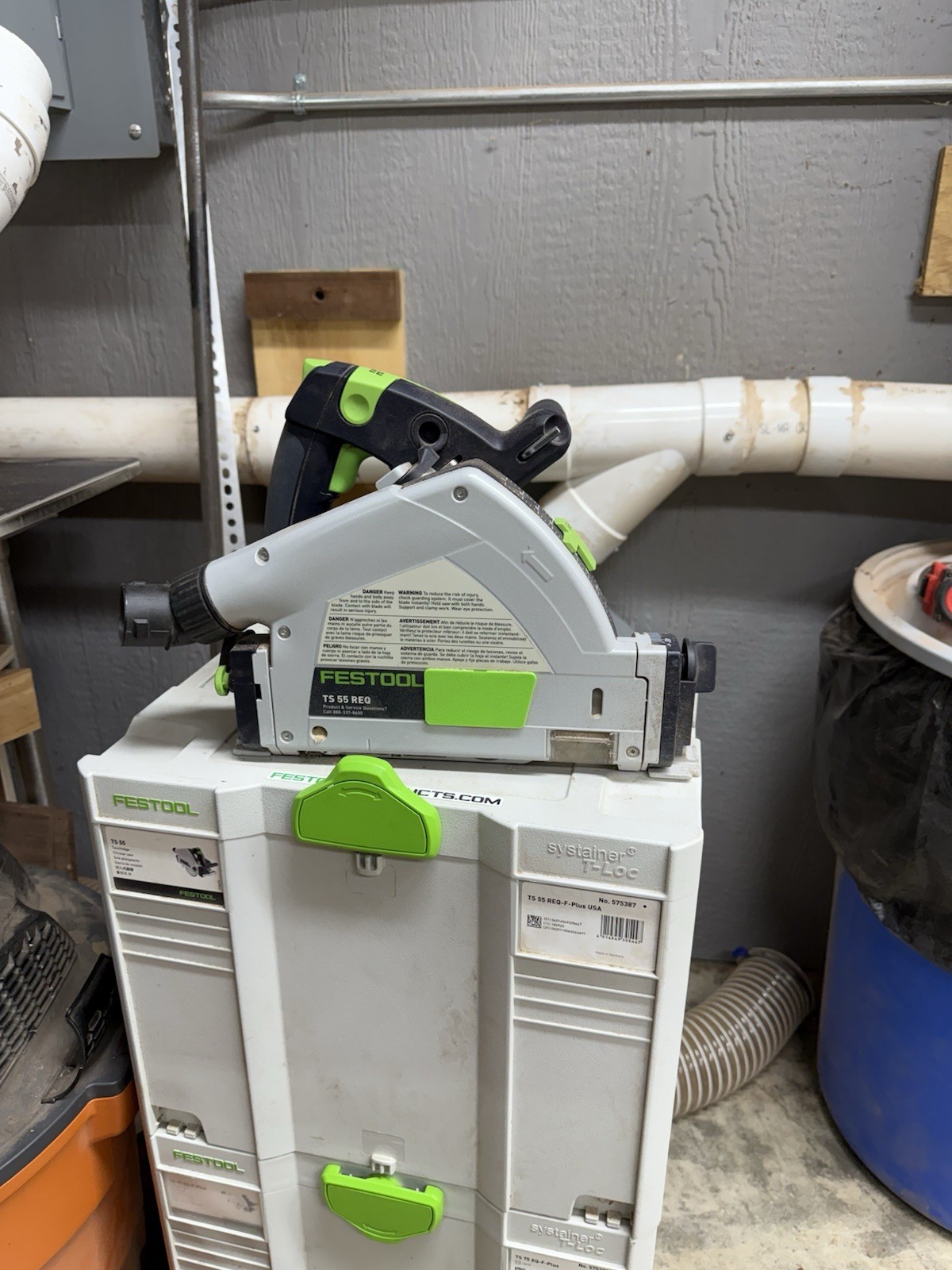
Track saws replace table saws for sheet goods and long rips. For cabinet installers, finish carpenters, and remodelers who work on-site, a track saw is more portable, more precise on sheet goods, and safer than wrestling 4x8 plywood through a jobsite table saw. The saw rides along an extruded aluminum guide rail, producing a factory-edge-quality cut without the need to clamp a straightedge or measure offsets. This guide compares five track saws based on manufacturer specifications, covering corded and cordless models in the $200-$650 range.
Key Specifications Explained
Before comparing individual models, it helps to understand the specifications that actually differentiate track saws in field use.
Cut depth at 0 degrees and 45 degrees. The maximum cut depth determines what materials the saw can handle. Most track saws cut between 47mm and 57mm at 0 degrees. For 3/4” plywood and MDF (the primary use case), anything above 20mm is sufficient. Deeper cuts matter for stacked sheet goods, solid hardwood countertops, and door slabs. Cut depth at 45 degrees is typically 30-40% less than at 0 degrees.
Track compatibility. This is one of the most significant purchasing considerations. Festool saws require Festool guide rails. Makita saws require Makita rails. DeWalt saws use DeWalt rails but adapters exist for some cross-compatibility. Kreg uses its own proprietary track system with a fundamentally different design (the saw rides on top of the track rather than sliding along the edge). Once a contractor commits to a track ecosystem, switching costs include replacing all guide rails, connectors, and parallel guides.
Anti-splinter strips. Most track systems include a replaceable strip along the cut line that supports wood fibers and prevents tearout on the visible face. According to manufacturer documentation, Festool’s splinterguard system and Kreg’s wide anti-chip strip are the most aggressive implementations. The effectiveness of the anti-splinter strip degrades with use and the strips need periodic replacement.
Dust collection efficiency. Track saws generate fine dust from plywood and MDF. Per manufacturer data, Festool claims up to 98% dust extraction when connected to a Festool dust extractor. Other manufacturers provide dust ports but do not publish specific extraction percentages. Dual-port designs (one on the blade guard, one on the riving area) generally capture more dust than single-port designs.
Plunge mechanism. All track saws use a plunge action where the blade descends into the workpiece from above. Spring-loaded plunge mechanisms (Festool, DeWalt) return the blade to the retracted position when the user releases pressure, which is a safety feature. Some models use a locking lever to set plunge depth; others rely on depth stops alone.
Corded vs. cordless. Corded track saws deliver consistent power without battery weight. Cordless models (DeWalt 60V FlexVolt, Milwaukee M18) offer jobsite freedom but add 2-4 lbs from the battery and may have reduced cut depth or slower blade speed under load compared to corded equivalents. For cabinet shops with wall outlets every 20 feet, corded makes sense. For remodelers working in unfinished spaces, cordless eliminates extension cord management.
Top Track Saws for Contractors
Festool TS 55 FEQ-F-Plus — Best Overall
| Specification | Value |
|---|---|
| Motor | 1,200W (corded) |
| Blade Size | 160mm (6-1/4”) |
| No-Load Speed | 2,000-5,200 RPM (variable) |
| Cut Depth at 0° | 55mm (2-3/16”) |
| Cut Depth at 45° | 43mm (1-11/16”) |
| Bevel Range | -1° to 47° |
| Weight | 4.5 kg (9.9 lbs) |
| Dust Collection | Dual ports, up to 98% extraction (with Festool extractor) |
| Track System | Festool proprietary |
| Warranty | 3 years (10 years with registration) |
| Price Range | $575-$650 (saw only); $700-$800 with guide rail |
According to Festool’s specifications, the TS 55 FEQ-F-Plus uses a spring-loaded plunge mechanism with a riving knife for kickback prevention. The variable speed dial (2,000-5,200 RPM) allows operators to match blade speed to material type — slower speeds for aluminum and plastics, higher speeds for wood. Per Festool’s product data, the splinterguard system uses a zero-clearance strip that mounts to the guide rail and sits directly against the workpiece surface, supporting fibers on both sides of the cut line. The -1 degree bevel capability allows undercutting for miter joint fitting. The FastFix blade change system is tool-free. Festool guide rails are available in lengths from 800mm to 5,000mm and connect end-to-end for longer cuts.
The Festool ecosystem cost is the primary objection. The saw alone is $575-$650. Adding a 1,400mm guide rail, connectors, and a Festool dust extractor can push total investment above $1,500. However, per industry data, Festool track saws have the highest resale value in the category, which partially offsets the upfront cost for contractors who eventually upgrade or change specialties.
Best for: Cabinet installers and finish carpenters who cut sheet goods daily and need the highest dust collection efficiency and cut quality available. The ecosystem cost is justified by daily use.
DeWalt DCS520T1 60V FlexVolt — Best Cordless
| Specification | Value |
|---|---|
| Motor/Battery | Brushless / 60V MAX FlexVolt |
| Blade Size | 6-1/2” (165mm) |
| No-Load Speed | 1,750-4,000 RPM (variable) |
| Cut Depth at 0° | 2-1/8” (54mm) |
| Cut Depth at 45° | 1-5/8” (41mm) |
| Bevel Range | 0° to 47° |
| Weight | 8.8 lbs (bare tool) |
| Dust Collection | Single port |
| Track System | DeWalt TrackSaw track |
| Warranty | 3 years |
| Price Range | $400-$475 (kit with battery and charger); $300-$350 bare tool |
Per DeWalt’s product documentation, the DCS520T1 uses the 60V MAX FlexVolt battery platform, which delivers higher sustained power than 20V MAX tools. The variable speed range of 1,750-4,000 RPM is lower than the Festool’s maximum, but according to DeWalt’s specifications, the brushless motor compensates with higher torque at lower RPM. The plunge mechanism is spring-loaded. The electronic brake stops the blade quickly after trigger release. DeWalt’s track system uses an anti-slip rubber strip on the underside and is available in 46” and 59” lengths. Track connectors allow joining multiple rails for longer cuts.
The cordless advantage is substantial for remodelers. Based on manufacturer data, the 60V FlexVolt battery provides enough runtime to make approximately 150-200 crosscuts in 3/4” plywood per charge, though actual numbers vary with blade condition and material density. For contractors already invested in the DeWalt 60V platform, the DCS520T1 shares batteries with the FlexVolt table saw, miter saw, and circular saw.
Best for: Remodelers and general contractors working in spaces without reliable power access. The FlexVolt platform provides genuine cordless capability without the power compromises of lower-voltage track saws.
Makita SP6000J1 — Best Value Corded
| Specification | Value |
|---|---|
| Motor | 12.0 Amp (corded) |
| Blade Size | 6-1/2” (165mm) |
| No-Load Speed | 2,000-5,200 RPM (variable) |
| Cut Depth at 0° | 2-3/16” (56.5mm) |
| Cut Depth at 45° | 1-5/8” (40mm) |
| Bevel Range | -1° to 48° |
| Weight | 9.7 lbs |
| Dust Collection | Single port |
| Track System | Makita proprietary |
| Warranty | 1 year |
| Price Range | $350-$420 (kit with 55” guide rail) |
According to Makita’s specifications, the SP6000J1 delivers 56.5mm of cut depth at 0 degrees — the deepest in this comparison and 1.5mm more than the Festool TS 55. The 12-amp motor matches the variable speed range of the Festool (2,000-5,200 RPM), and the -1 degree bevel capability is also present. Per Makita’s product data, the saw includes electronic speed control to maintain RPM under load, a soft start for controlled plunge entry, and an electric brake. The SP6000J1 kit ships with a 55” guide rail, which is long enough for crosscuts on 4x8 sheet goods.
The value proposition is straightforward. Based on manufacturer pricing data, the Makita kit with a 55” guide rail costs roughly what the Festool saw costs alone, without any track. The specifications are competitive or superior in most measurable categories. The tradeoff is in ecosystem depth: Makita offers fewer track lengths, no integrated dust extraction ecosystem, and a shorter warranty (1 year vs. Festool’s 3-10 years). The anti-splinter strip system is functional but less refined than Festool’s splinterguard.
Best for: Contractors who need track saw precision without committing to the Festool ecosystem price. The SP6000J1 delivers specifications that match or exceed the Festool TS 55 at roughly half the system cost.
Kreg ACS-SAW — Best for Sheet Goods and Cabinet Shops
| Specification | Value |
|---|---|
| Motor | 12.0 Amp (corded) |
| Blade Size | 6-1/2” (165mm) |
| No-Load Speed | 2,000-5,200 RPM (variable) |
| Cut Depth at 0° | 2-1/16” (52mm) |
| Cut Depth at 45° | 1-1/2” (38mm) |
| Bevel Range | 0° to 47° |
| Weight | 9.5 lbs |
| Dust Collection | Integrated port |
| Track System | Kreg proprietary (saw-on-top design) |
| Warranty | 3 years |
| Price Range | $350-$400 (saw only); $500-$600 with track |
Per Kreg’s product specifications, the ACS-SAW uses a fundamentally different track interface than competing models. Rather than the saw hanging below and sliding along the rail edge, the Kreg saw rides on top of a wide, flat guide track. According to Kreg’s documentation, this design provides a wider anti-chip strip area and positions the operator’s hands further from the workpiece. The guide track includes a built-in material clamp that holds the track to the workpiece without separate clamps.
The on-top-of-track design has specific advantages for sheet goods work. Based on manufacturer data, the wider anti-chip contact area reduces tearout across a broader zone than edge-riding designs. The built-in track clamp eliminates a step in the setup process. However, the design produces a slightly shallower cut depth (52mm vs. 55-56.5mm for Festool and Makita) and the track system is not compatible with any other saw brand. The Kreg track is available in 50” and 100” lengths.
Best for: Cabinet shops and installers who primarily break down sheet goods and value the anti-chip performance and clamping convenience over maximum cut depth or ecosystem flexibility.
Milwaukee 2831-20 M18 FUEL — Best for Milwaukee Users
| Specification | Value |
|---|---|
| Motor/Battery | Brushless (POWERSTATE) / M18 18V |
| Blade Size | 6-1/2” (165mm) |
| No-Load Speed | 2,000-5,000 RPM (variable) |
| Cut Depth at 0° | 1-7/8” (47.6mm) |
| Cut Depth at 45° | 1-3/8” (35mm) |
| Bevel Range | 0° to 47° |
| Weight | 7.4 lbs (bare tool) |
| Dust Collection | Single port |
| Track System | Milwaukee proprietary |
| Warranty | 5 years |
| Price Range | $350-$400 (bare tool) |
According to Milwaukee’s product specifications, the 2831-20 uses the M18 FUEL platform with a brushless POWERSTATE motor. The variable speed range of 2,000-5,000 RPM is competitive, and Milwaukee’s REDLINK PLUS electronics protect against overload and overheating. Per Milwaukee’s data, the saw features a one-handed plunge mechanism that allows operators to control the plunge descent while maintaining a grip on the front handle. The electronic blade brake stops the blade within seconds of trigger release.
The tradeoff with the Milwaukee is cut depth. At 47.6mm (1-7/8”) at 0 degrees, the 2831-20 has the shallowest maximum cut in this comparison — roughly 8-9mm less than the Festool and Makita. This is sufficient for 3/4” sheet goods but limits the saw’s utility for thicker solid wood, stacked panels, or door slabs. The M18 platform advantage is ecosystem compatibility: contractors invested in Milwaukee’s 250+ M18 tools can use the same batteries without buying into a separate voltage platform.
Best for: Contractors already committed to the M18 battery ecosystem who need track saw capability for standard sheet goods without investing in a separate battery platform or corded tool.
Comparison Summary
| Feature | Festool TS 55 | DeWalt DCS520T1 | Makita SP6000J1 | Kreg ACS-SAW | Milwaukee 2831-20 |
|---|---|---|---|---|---|
| Power Source | Corded (1,200W) | 60V FlexVolt | Corded (12A) | Corded (12A) | M18 18V |
| Cut Depth 0° | 55mm | 54mm | 56.5mm | 52mm | 47.6mm |
| Cut Depth 45° | 43mm | 41mm | 40mm | 38mm | 35mm |
| Speed Range | 2,000-5,200 | 1,750-4,000 | 2,000-5,200 | 2,000-5,200 | 2,000-5,000 |
| Weight | 9.9 lbs | 8.8 lbs (bare) | 9.7 lbs | 9.5 lbs | 7.4 lbs (bare) |
| Bevel Range | -1° to 47° | 0° to 47° | -1° to 48° | 0° to 47° | 0° to 47° |
| Warranty | 3-10 years | 3 years | 1 year | 3 years | 5 years |
| Price (saw only) | $575-$650 | $300-$350 | $250-$300 | $350-$400 | $350-$400 |
Track Saw vs. Table Saw
The track saw vs. table saw decision depends on the type of work and where it happens.
Track saw advantages: Cuts happen at the workpiece, not at the tool. A contractor can lay a 4x8 sheet of plywood on sawhorses, place the track, and make a clean rip without needing a second person to support outfeed. Track saws are portable — the saw and a 55” rail fit in a carrying case. For jobsite work in occupied homes (remodels, cabinet installs), the dust collection and compact footprint of a track saw are significant practical advantages.
Table saw advantages: Repetitive rips at the same width are faster on a table saw with a fence. Dado cuts, rabbets, and tenons require a table saw (or router). Long rips in solid hardwood benefit from the table saw’s larger motor and continuous fence reference. For shop-based work with consistent power access, a cabinet table saw is more productive for batch processing.
The crossover point: Contractors who primarily break down sheet goods on-site and do finish work (casework, built-ins, trim) will get more utility from a track saw. Contractors who primarily rip solid lumber in a shop setting will get more utility from a table saw. Many finish carpenters own both: a table saw in the shop for batch work and a track saw in the van for on-site cuts.
Track Compatibility Notes
Track compatibility is a locked-in decision. Switching ecosystems means replacing every rail, connector, and accessory.
- Festool: Proprietary guide rails. Available from 800mm to 5,000mm. Connectors join rails end-to-end. Parallel guide and angle stop accessories available. No third-party saws are compatible without modification.
- Makita: Proprietary guide rails. Available in 39” and 55” lengths. Connectors available. Not cross-compatible with Festool or DeWalt tracks.
- DeWalt: Uses its own TrackSaw track system. Available in 46” and 59” lengths. Some aftermarket adapters claim cross-compatibility with Festool tracks, but DeWalt does not endorse or warranty this usage.
- Kreg: Unique wide-format track designed for the saw-on-top configuration. Available in 50” and 100” lengths. Not compatible with any other brand.
- Milwaukee: Proprietary track system. Track lengths and accessory ecosystem are the newest and smallest in this comparison, as Milwaukee entered the track saw market later than the other brands.
Who This Is NOT For
A track saw is a specialized tool. It is the wrong purchase for several common contractor profiles:
- Framers ripping 2x lumber. Track saws are designed for sheet goods and finish-grade cuts. A circular saw handles dimensional lumber faster and cheaper. The track saw’s plunge mechanism and guide rail add setup time that is counterproductive for rough framing cuts.
- Contractors who primarily do crosscuts. A miter saw (best miter saws for contractors) is faster and more accurate for crosscutting trim, molding, and framing members. Track saws can crosscut, but the setup time per cut is higher.
- Anyone on a budget under $200. No quality track saw system (saw plus rail) falls below $350. Budget “track saw” products in the $100-$150 range are typically circular saws with improvised guide accessories and do not deliver the precision or anti-splinter performance that defines the category.
- Contractors with a cabinet table saw in a fixed shop. If the shop already has a quality table saw with an outfeed table and the work rarely leaves the shop, a track saw duplicates capability without adding much. The track saw’s advantage is portability — if portability is not needed, the table saw is likely the better tool for the job.
- Anyone expecting a track saw to replace a circular saw entirely. Track saws are slower to set up for each cut. For quick, rough cuts on-site — trimming studs, cutting sheathing to rough dimensions, notching — a standard circular saw with a speed square is faster and more practical.
Sources
- Festool TS 55 FEQ-F-Plus product specifications and technical data (festool.com)
- DeWalt DCS520T1 60V MAX FlexVolt Track Saw product specifications (dewalt.com)
- Makita SP6000J1 6-1/2” Plunge Circular Saw with Guide Rail specifications (makitatools.com)
- Kreg ACS-SAW Adaptive Cutting System product specifications (kregtool.com)
- Milwaukee 2831-20 M18 FUEL 6-1/2” Plunge Track Saw specifications (milwaukeetool.com)