Best Auto-Darkening Welding Helmets in 2026
An auto-darkening welding helmet adjusts its lens shade automatically when it detects an arc, eliminating the need to manually flip a fixed-shade lens before striking. According to ANSI Z87.1 standards, auto-darkening filters (ADF) must transition from a light state (typically shade 3 or 4) to a dark welding state (shade 8-13) fast enough to protect the welder’s eyes before arc radiation causes damage. The quality of that transition — how fast, how consistently, and how clearly the lens performs — separates a helmet that prevents eye strain from one that causes it.
This guide compares five auto-darkening helmets spanning $50 to $400, evaluated on manufacturer-published specifications for lens reaction time, optical clarity, viewing area, shade range, sensor count, and comfort. All specs and claims are sourced from product data sheets and manufacturer documentation.
Key Specs That Matter
Before comparing individual helmets, understanding which specifications actually affect welding performance is critical:
- Optical clarity rating: Expressed as four numbers (e.g., 1/1/1/1) per EN379 standards, rating clarity, diffusion, homogeneity, and angle dependence. Lower numbers are better. A 1/1/1/1 rating is the highest achievable and means the lens produces minimal distortion across all four categories.
- Reaction time (light to dark): Measured in fractions of a second. Per manufacturer specs, premium helmets switch in 1/20,000s (0.05ms), while budget models may take 1/10,000s (0.1ms) or slower. Faster reaction times matter most for TIG welding at low amperages, where the arc is less intense and slower lenses may not trigger consistently.
- Viewing area: Measured in square inches. Larger viewing areas reduce the need to reposition the head to see the weld joint and surrounding workpiece. This directly affects weld quality on longer beads and in tight joint configurations.
- Shade range: Most helmets offer shade 9-13 for welding. Helmets with a grinding mode (shade 3-4) or low-amperage capability (shade 5-8) offer additional utility for TIG welding at low amperages and non-welding tasks.
- Number of sensors: Sensors detect the arc and trigger the lens transition. Two-sensor helmets can fail to darken if one sensor is blocked by the workpiece or fixturing. Four sensors provide redundant coverage and are recommended for out-of-position welding.
- Power source: Solar-powered helmets with battery backup offer the longest service life. Battery-only models require periodic replacement, which can be inconvenient if the battery type is proprietary.
Top Picks Based on Specifications
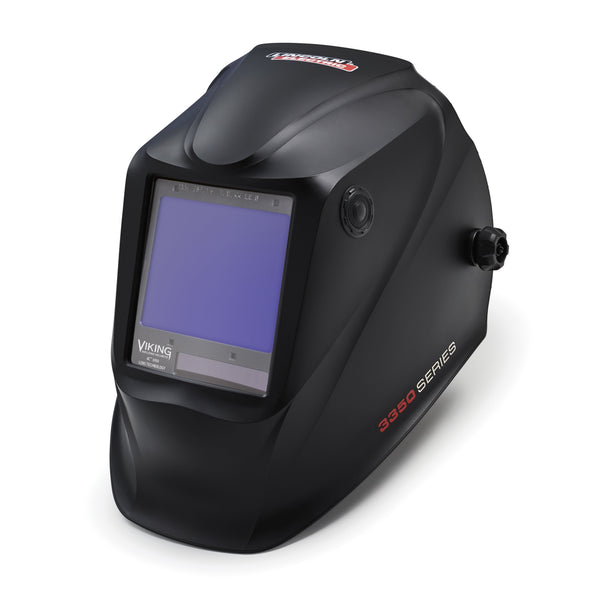
Lincoln Electric Viking 3350 — Best Overall
| Spec | Value |
|---|---|
| Viewing Area | 12.5 sq in (3.74” x 3.34”) |
| Shade Range | 5-13 |
| Reaction Time | 1/20,000s |
| Optical Clarity | 1/1/1/1 |
| Sensors | 4 |
| Weight | 18 oz |
| Power Source | Solar with lithium battery backup |
| Grind Mode | Yes (external button) |
| Warranty | 3 years |
| Price Range | $290-$350 |
According to Lincoln Electric’s specifications, the Viking 3350 features 4C lens technology, which achieves a 1/1/1/1 optical clarity rating across all four EN379 categories. Per Lincoln’s product documentation, this means the lens produces minimal color distortion — objects viewed through the lens appear closer to their true colors, which helps distinguish weld puddle behavior and base metal heat zones.
The 12.5 square inch viewing area is among the largest in any welding helmet at this price point. Lincoln rates the shell at 4.5” longer in the chin area compared to standard helmets, providing additional throat and neck coverage from UV exposure and spatter. The shade 5-13 range covers everything from low-amperage TIG work to high-amperage stick and gouging.
Per Lincoln’s technical data, the external grind mode button allows switching to shade 3.5 without lifting the helmet, a convenience feature for grinding and prep work between welds.
Best for: Fabricators and serious hobbyists who weld across multiple processes (MIG, TIG, stick) and need optical clarity that reduces eye fatigue over long sessions. The wide shade range and four-sensor array make it versatile enough for both low-amperage TIG and high-amperage stick.
Limitation: At 18 oz, it is heavier than some competitors. For all-day overhead welding, that weight difference is noticeable by mid-shift.
Miller Digital Infinity — Premium Comfort
| Spec | Value |
|---|---|
| Viewing Area | 13.4 sq in (3.93” x 2.38”) |
| Shade Range | 3, 5-13 |
| Reaction Time | 1/20,000s |
| Optical Clarity | 1/1/1/1 |
| Sensors | 4 |
| Weight | 17.3 oz |
| Power Source | Solar with lithium battery backup |
| Grind Mode | Yes (shade 3) |
| Warranty | 3 years |
| Price Range | $330-$400 |
Per Miller’s technical documentation, the Digital Infinity uses ClearLight lens technology with a 1/1/1/1 optical clarity rating and what Miller describes as an improved light state — the shade 3 light state is brighter and clearer than typical shade 4 light states, improving visibility before the arc is struck. This matters when positioning the torch or electrode on the joint.
The 13.4 square inch viewing area is the largest on this list. According to Miller’s product data, the helmet uses an InfoTrack system with an internal LCD display showing arc time, arc count, and peak amperage — useful for monitoring duty cycle and tracking weld parameters. The headgear uses Miller’s X-Mode electromagnetic sensing, which per their documentation, uses electromagnetic field detection in addition to optical sensors to prevent the lens from accidentally darkening from sunlight or other non-arc light sources.
Best for: Professional welders and shop owners who need the largest possible viewing area and premium comfort for extended sessions. The X-Mode arc detection is particularly useful for outdoor welding where sunlight can cause false triggers on standard helmets.
Limitation: The highest price on this list at $330-$400. The performance difference over the Lincoln Viking 3350 is marginal for most hobbyists. The premium is justified primarily for professionals welding six or more hours per day.
ESAB Sentinel A50 — Best Ergonomic Design
| Spec | Value |
|---|---|
| Viewing Area | 9.22 sq in (3.93” x 2.36”) |
| Shade Range | 5-13 |
| Reaction Time | 1/25,000s |
| Optical Clarity | 1/1/1/2 |
| Sensors | 5 |
| Weight | 21 oz |
| Power Source | Solar with CR2450 lithium battery backup |
| Grind Mode | Yes (external) |
| Warranty | 2 years |
| Price Range | $250-$310 |
According to ESAB’s specifications, the Sentinel A50 features a 1/25,000 second reaction time — the fastest on this list. The five-sensor array (compared to four on most competitors) provides additional arc detection redundancy, which per ESAB’s documentation reduces the chance of the lens failing to darken during out-of-position or obstructed welding.
ESAB describes the Sentinel A50’s shell design as a departure from traditional helmet geometry. Per their product data, the hood wraps closer to the head than conventional designs, which is intended to reduce overall bulk and improve balance. The touch-sensitive control panel inside the helmet allows shade and sensitivity adjustments without removing the helmet.
The viewing area at 9.22 square inches is smaller than the Lincoln and Miller, but the lens aspect ratio (wider than tall) prioritizes horizontal field of view, which according to ESAB’s documentation aligns with natural eye movement during welding.
Best for: Welders who prioritize reaction speed and a modern, close-fitting helmet design. The five-sensor array and fastest-in-class reaction time make it well-suited for TIG welding at low amperages where arc detection reliability is most critical.
Limitation: At 21 oz, it is the heaviest helmet on this list. The 2-year warranty is shorter than Lincoln and Miller offerings. The optical clarity rating of 1/1/1/2 (angle dependence) is slightly below the 1/1/1/1 achieved by the Lincoln and Miller lenses.
Hobart 770890 — Best Budget-Friendly Option
| Spec | Value |
|---|---|
| Viewing Area | 7.5 sq in (3.6” x 2.1”) |
| Shade Range | 10-13 |
| Reaction Time | 1/12,000s |
| Optical Clarity | 1/1/1/2 |
| Sensors | 2 |
| Weight | 16 oz |
| Power Source | Solar with AAA battery backup |
| Grind Mode | No |
| Warranty | 1 year |
| Price Range | $80-$120 |
Per Hobart’s product specifications, the 770890 provides a 1/12,000 second switching speed and two arc sensors. The shade range of 10-13 covers standard MIG, stick, and flux-core applications but does not include low shades needed for low-amperage TIG welding. According to Hobart’s data sheet, the sensitivity and delay controls are accessible via knobs inside the helmet shell.
At 16 oz, it is the lightest helmet on this list. Hobart specifies AAA battery backup alongside solar charging, meaning battery replacement uses standard, widely available batteries rather than proprietary cells.
The 7.5 square inch viewing area is adequate for hobbyist MIG and stick welding, though noticeably smaller than premium helmets. Per Hobart’s documentation, the headgear uses a ratchet adjustment system with a padded headband.
Best for: Hobbyists and beginners on a budget who primarily weld MIG or stick and need a reliable, lightweight helmet from a recognized brand. Paired with a MIG welder for beginners, this represents a solid entry-level setup.
Limitation: Two sensors increase the risk of the lens not darkening if one sensor is blocked. No grind mode means lifting the helmet for grinding tasks. The narrower shade range (10-13) eliminates low-amperage TIG work. The 1-year warranty is the shortest here.
YesWelder LYG-M800H — Best Entry-Level
| Spec | Value |
|---|---|
| Viewing Area | 14.5 sq in (3.94” x 3.66”) |
| Shade Range | 4/5-9, 9-13 |
| Reaction Time | 1/10,000s |
| Optical Clarity | 1/1/1/2 |
| Sensors | 4 |
| Weight | 19.5 oz |
| Power Source | Solar with lithium battery backup |
| Grind Mode | Yes |
| Warranty | 2 years |
| Price Range | $50-$80 |
According to YesWelder’s specifications, the LYG-M800H offers the largest viewing area on this list at 14.5 square inches — exceeding even the Miller Digital Infinity. The lens provides a dual shade range: shade 4/5-9 for low-amperage work and grinding, plus shade 9-13 for standard welding. Four arc sensors provide better detection coverage than two-sensor budget competitors.
Per YesWelder’s product data, the helmet includes both sensitivity and delay adjustment knobs. The reaction time of 1/10,000 second is the slowest on this list, which may be noticeable during rapid tack welding sequences or very low-amperage TIG work.
Best for: Beginners and budget-conscious buyers who want a large viewing area and four-sensor coverage without the $250+ price tag. The feature set on paper exceeds many helmets at twice the price.
Limitation: YesWelder is a newer brand without established long-term reliability data. Per aggregated user feedback on third-party review platforms, lens clarity and headgear durability are the most common concerns. The 1/10,000s reaction time is adequate for MIG and stick but may be too slow for comfortable low-amperage TIG welding. Optical quality claims should be evaluated cautiously — third-party optical testing data for this model is not publicly available.
Who This Is NOT For
Not every welder needs an auto-darkening helmet, and not every auto-darkening helmet on this list is appropriate for every application:
-
Production TIG welders working below 20 amps. At very low amperages, the arc intensity may not reliably trigger budget auto-darkening lenses. Per manufacturer documentation, helmets with reaction times slower than 1/15,000s and fewer than four sensors may fail to darken consistently at amperages below 20A. For dedicated low-amperage TIG work, the Lincoln Viking 3350 or ESAB Sentinel A50 are the minimum recommendations based on their reaction time and sensor specifications.
-
Welders working primarily in direct sunlight. Standard optical sensors can produce false triggers in bright sunlight, causing the lens to darken when no arc is present. Miller’s X-Mode electromagnetic detection addresses this, but the other helmets on this list rely on optical sensing alone. A passive fixed-shade lens may be more reliable for consistent outdoor work.
-
Anyone who needs a respirator-compatible helmet. Not all helmets on this list are compatible with powered air-purifying respirators (PAPRs) or half-face respirators. If welding galvanized steel, stainless steel, or other materials that produce hazardous fumes, verify respirator compatibility with the specific helmet model before purchasing.
-
Buyers looking to spend under $40. Unbranded auto-darkening helmets below $40 frequently lack ANSI Z87.1 certification, use slow-switching lenses (1/5,000s or worse), and have no meaningful warranty. Per ANSI standards, an uncertified lens may not provide adequate UV/IR protection even in the darkened state. Eye safety should not be treated as a budget line item.
Full Comparison Table
| Spec | Lincoln Viking 3350 | Miller Digital Infinity | ESAB Sentinel A50 | Hobart 770890 | YesWelder LYG-M800H |
|---|---|---|---|---|---|
| Viewing Area | 12.5 sq in | 13.4 sq in | 9.22 sq in | 7.5 sq in | 14.5 sq in |
| Shade Range | 5-13 | 3, 5-13 | 5-13 | 10-13 | 4/5-9, 9-13 |
| Reaction Time | 1/20,000s | 1/20,000s | 1/25,000s | 1/12,000s | 1/10,000s |
| Optical Clarity | 1/1/1/1 | 1/1/1/1 | 1/1/1/2 | 1/1/1/2 | 1/1/1/2 |
| Sensors | 4 | 4 | 5 | 2 | 4 |
| Weight | 18 oz | 17.3 oz | 21 oz | 16 oz | 19.5 oz |
| Power Source | Solar + lithium | Solar + lithium | Solar + CR2450 | Solar + AAA | Solar + lithium |
| Grind Mode | Yes | Yes | Yes | No | Yes |
| Warranty | 3 yr | 3 yr | 2 yr | 1 yr | 2 yr |
| Price Range | $290-$350 | $330-$400 | $250-$310 | $80-$120 | $50-$80 |
Sources
- Lincoln Electric Viking 3350 product specifications and 4C lens technology documentation (lincolnelectric.com)
- Miller Digital Infinity ClearLight lens technology and X-Mode documentation (millerwelds.com)
- ESAB Sentinel A50 product specifications and user manual (esab.com)
- Hobart 770890 product data sheet and specifications (hobartwelders.com)
- YesWelder LYG-M800H product specifications (yeswelder.com)
- ANSI/ISEA Z87.1-2020 — Occupational and Educational Personal Eye and Face Protection Devices
- EN379 — Personal eye-equipment: Automatic welding filters