Best Bench Grinders for Home Shops in 2026
A bench grinder is one of the most straightforward tools in any home shop, yet buying the wrong one leads to specific, avoidable frustrations: excessive vibration that makes precision work impossible, underpowered motors that stall under load, or wheels too small to handle the work at hand. This guide evaluates five bench grinders spanning $50 to $300 based on published manufacturer specifications, focusing on wheel size, motor power, vibration control, adjustability, and warranty coverage.
All specs, claims, and price ranges cited below are sourced from manufacturer product data sheets and publicly available documentation.
What Separates a Good Bench Grinder from a Bad One
Per manufacturer specifications and industry standards, the factors that matter most for home shop use are:
- Motor power: Expressed in HP or amps. For general grinding, deburring, and tool sharpening, 1/2 HP is the practical minimum. Motors under 1/3 HP tend to bog down on anything harder than light deburring.
- Wheel size: 6-inch and 8-inch are the standard home shop sizes. Larger wheels provide more surface area and run at higher surface speed at the same RPM.
- Vibration control: The single biggest quality differentiator. Rubber feet, precision-balanced wheels, and cast iron construction all reduce vibration. Excessive vibration makes freehand sharpening nearly impossible.
- Eye shields and tool rests: Safety features that also affect usability. Adjustable, cast tool rests hold position better than stamped sheet metal rests. Large, clear eye shields that resist fogging improve both safety and visibility.
- Speed: Standard bench grinders run at 3,450-3,600 RPM. Slow-speed grinders (1,750 RPM or variable) are specifically designed for sharpening edge tools without overheating.
6-Inch vs. 8-Inch: Which Wheel Size?
This is the first decision, and it drives everything else. According to manufacturer specifications, the differences are measurable:
| Factor | 6-Inch Wheels | 8-Inch Wheels |
|---|---|---|
| Surface speed at 3,600 RPM | ~5,655 SFM | ~7,540 SFM |
| Wheel life (more material to wear) | Shorter | Longer |
| Motor power (typical) | 1/3 - 1/2 HP | 1/2 - 3/4 HP |
| Price range | $40-$120 | $100-$350 |
| Bench footprint | Smaller | Larger |
| Material removal rate | Lower | Higher |
| Typical weight | 15-25 lbs | 25-45 lbs |
Choose 6-inch if the primary use is occasional touch-ups, light deburring, and the bench space is limited. A 6-inch grinder is adequate for sharpening lawn mower blades, cleaning up small parts, and quick deburring tasks.
Choose 8-inch if the grinder will see regular use for sharpening larger tools, grinding stock removal, or any task where surface speed and wheel life matter. The higher surface speed of an 8-inch wheel at the same RPM removes material faster and more efficiently. Per manufacturer guidance, 8-inch grinders are the standard recommendation for shops where the grinder is used multiple times per week.
Top Picks Based on Specifications
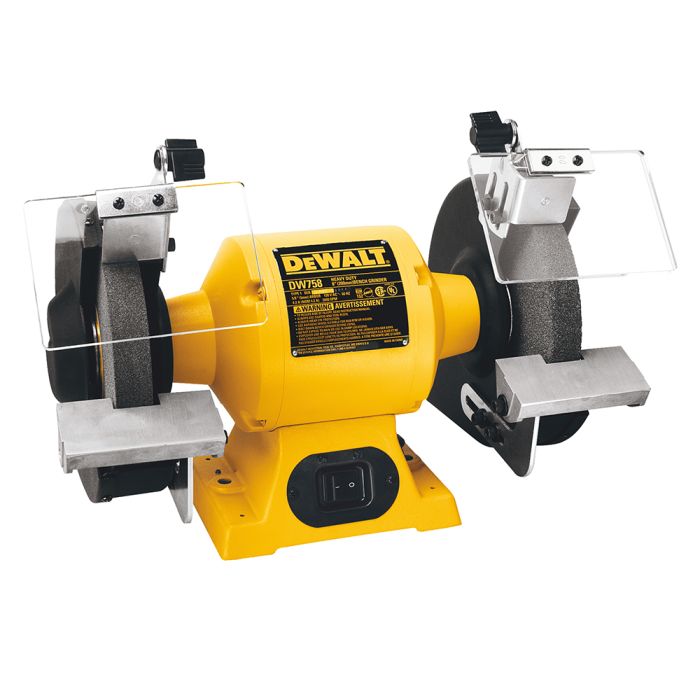
DeWalt DW758 — Best All-Around 8-Inch Grinder
| Spec | Value |
|---|---|
| Wheel Size | 8-inch (diameter) x 1-inch (width) |
| Motor Power | 3/4 HP |
| Speed | 3,600 RPM |
| Arbor Size | 5/8 inch |
| Eye Shields | Large adjustable with clear lens |
| Tool Rests | Cast aluminum, adjustable angle |
| Weight | 26.1 lbs |
| Warranty | 3 years limited |
| Price Range | $120-$170 |
According to DeWalt’s product data sheet, the DW758 uses a 3/4 HP induction motor rated for continuous duty. The cast aluminum tool rests are a meaningful upgrade over the stamped steel rests found on budget grinders — they maintain their position under side pressure and provide a more stable platform for freehand grinding.
Per DeWalt’s specifications, the DW758 features rear exhaust ports designed to direct grinding dust away from the operator. The 5/8-inch arbor is the industry standard for 8-inch wheels, which means replacement wheels are widely available from multiple manufacturers. The 36-grit and 60-grit wheels included from the factory are serviceable for general grinding but should be replaced with premium wheels (Norton, CGW, or similar) for precision sharpening work.
Best for: Home shop owners who need a reliable, mid-priced grinder for regular use. The 3/4 HP motor handles tool sharpening, deburring, and light stock removal without stalling. The combination of cast tool rests, adequate power, and a 3-year warranty makes this the strongest overall value in the 8-inch category.
Limitation: At 3,600 RPM, the DW758 is a full-speed grinder. According to sharpening guides from multiple tool manufacturers, high-speed grinding can draw the temper from thin edge tools (chisels, plane irons) if the operator does not use light pressure and frequent cooling. Buyers whose primary use is edge tool sharpening should consider the Rikon 80-805 below.
JET 577102 JBG-8A — Premium Build Quality
| Spec | Value |
|---|---|
| Wheel Size | 8-inch (diameter) x 1-inch (width) |
| Motor Power | 1 HP |
| Speed | 3,450 RPM |
| Arbor Size | 5/8 inch |
| Eye Shields | Industrial cast, adjustable |
| Tool Rests | Cast iron, adjustable angle |
| Weight | 44 lbs |
| Warranty | 2 years (JET standard) |
| Price Range | $220-$300 |
Per JET’s product documentation, the JBG-8A uses a 1 HP industrial-rated motor — the most powerful unit on this list. The cast iron base and wheel guards contribute to the 44 lb total weight, which is itself a vibration-damping feature. Heavier grinders transmit less vibration to the bench and to the workpiece.
According to JET’s specifications, the JBG-8A includes cast iron tool rests and industrial-grade eye shields with a wider field of view than consumer-grade models. The pre-installed 36-grit and 60-grit aluminum oxide wheels are standard, but the machine’s build quality is designed to support extended use with premium grinding and wire wheel accessories.
Best for: Shop owners who use a bench grinder frequently and want industrial build quality that resists vibration over thousands of hours. The 1 HP motor provides headroom for grinding tasks that would stall a 1/2 HP unit — heavy deburring, aggressive stock removal, and sustained use with wire wheels.
Limitation: At $220-$300, the JBG-8A costs nearly twice as much as the DeWalt DW758 while offering a similar feature set. The premium buys build quality and motor power, not additional features. For occasional home shop use, the cost difference may not be justified. The 2-year warranty is also shorter than DeWalt’s 3-year coverage.
Rikon 80-805 — Best for Sharpening
| Spec | Value |
|---|---|
| Wheel Size | 8-inch (diameter) x 1-inch (width) |
| Motor Power | 1/2 HP |
| Speed | 1,750 RPM |
| Arbor Size | 5/8 inch |
| Eye Shields | Adjustable with clear lens |
| Tool Rests | Cast, adjustable angle and height |
| Weight | 30 lbs |
| Warranty | 5 years limited |
| Price Range | $150-$200 |
According to Rikon’s product documentation, the 80-805 runs at 1,750 RPM — exactly half the speed of standard bench grinders. This slow-speed operation is specifically designed for sharpening edge tools (chisels, plane irons, lathe tools, drill bits) without overheating or drawing the temper from hardened steel. Per metallurgical references, tool steel loses its hardness when heated above approximately 400-500 degrees Fahrenheit, which standard 3,600 RPM grinders can reach quickly with sustained contact.
Rikon specifies that the 80-805 ships with a 60-grit white aluminum oxide wheel and an 80-grit wheel. White aluminum oxide runs cooler than the gray aluminum oxide wheels included with most standard grinders, which further reduces heat buildup during sharpening. The combination of slow speed and cooler-running wheels makes this grinder purpose-built for edge tool maintenance.
Best for: Woodworkers and shop owners whose primary bench grinder use is sharpening edge tools. The slow speed and white aluminum oxide wheels are the correct combination for maintaining chisels, plane irons, and turning tools. The 5-year warranty is the longest on this list.
Limitation: The 1/2 HP motor and 1,750 RPM speed mean this grinder removes material slowly. It is not designed for aggressive stock removal, heavy deburring, or grinding tasks where speed and power are more important than heat control. Buyers who need both sharpening and general grinding should consider owning two grinders or choosing the DeWalt DW758 and learning to manage heat with light pressure and frequent dipping.
WEN 4276 — Best Budget Option
| Spec | Value |
|---|---|
| Wheel Size | 6-inch (diameter) x 3/4-inch (width) |
| Motor Power | 2.1 Amps (~1/3 HP equivalent) |
| Speed | 3,450 RPM |
| Arbor Size | 1/2 inch |
| Eye Shields | Adjustable, plastic |
| Tool Rests | Stamped steel, adjustable angle |
| Weight | 15.4 lbs |
| Warranty | 2 years limited |
| Price Range | $45-$65 |
Per WEN’s product specifications, the 4276 is a no-frills 6-inch grinder that covers the basics at the lowest price point on this list. The 2.1A motor produces approximately 1/3 HP — adequate for light sharpening, deburring, and occasional cleanup work. According to WEN’s documentation, the machine includes two 36-grit aluminum oxide wheels, adjustable eye shields, and stamped steel tool rests.
At 15.4 lbs, this is the lightest grinder listed, which also means it is the most prone to vibration and movement during use. According to manufacturer recommendations, bolting any bench grinder to the workbench improves performance, but this is especially important for lightweight units like the WEN 4276.
Best for: Home shop owners on a tight budget who need occasional grinding capability. At under $65, this grinder is inexpensive enough that it pays for itself after a few uses that would otherwise require a trip to a sharpening service. Adequate for lawn mower blades, garden tools, and light deburring.
Limitation: The stamped steel tool rests flex under pressure and do not hold angles as precisely as cast rests. The 1/2-inch arbor limits wheel selection compared to the 5/8-inch standard used by 8-inch grinders. The 1/3 HP motor will bog down under heavy load. This is a light-duty tool for occasional use, not a shop workhorse.
Craftsman CMEG100 — Budget 6-Inch Alternative
| Spec | Value |
|---|---|
| Wheel Size | 6-inch (diameter) x 3/4-inch (width) |
| Motor Power | 2.5 Amps (~1/3 HP equivalent) |
| Speed | 3,450 RPM |
| Arbor Size | 1/2 inch |
| Eye Shields | Adjustable, plastic lens |
| Tool Rests | Stamped steel, adjustable |
| Weight | 18.3 lbs |
| Warranty | 3 years limited |
| Price Range | $55-$80 |
According to Craftsman’s product data sheet, the CMEG100 offers a slight step up from the entry-level WEN in motor amperage (2.5A vs. 2.1A) and includes a 3-year warranty versus WEN’s 2-year coverage. Per Craftsman’s specifications, the unit includes a built-in work light positioned between the two wheel guards, which is a useful feature for visibility during close-tolerance work that most budget grinders lack.
The construction follows the standard budget bench grinder pattern: stamped steel tool rests, plastic eye shields, and a 1/2-inch arbor. According to Craftsman’s documentation, the base includes rubber feet for vibration dampening, though at 18.3 lbs the unit still benefits from being bolted to a bench.
Best for: Budget buyers who want a marginally more capable 6-inch grinder than the WEN and value the longer warranty and built-in work light. The Craftsman brand is widely available at Lowe’s, which simplifies warranty claims compared to online-only brands.
Limitation: Like the WEN, this is a light-duty grinder with stamped tool rests and a 1/2-inch arbor. The motor improvement over the WEN is marginal — both will bog down under sustained heavy grinding. The $10-15 premium over the WEN buys a work light and an extra year of warranty, which may or may not justify the price difference depending on the buyer’s priorities.
Full Comparison Table
| Spec | DeWalt DW758 | JET JBG-8A | Rikon 80-805 | WEN 4276 | Craftsman CMEG100 |
|---|---|---|---|---|---|
| Wheel Size | 8” x 1” | 8” x 1” | 8” x 1” | 6” x 3/4” | 6” x 3/4” |
| Motor Power | 3/4 HP | 1 HP | 1/2 HP | 2.1A (~1/3 HP) | 2.5A (~1/3 HP) |
| Speed (RPM) | 3,600 | 3,450 | 1,750 | 3,450 | 3,450 |
| Arbor Size | 5/8” | 5/8” | 5/8” | 1/2” | 1/2” |
| Tool Rest Material | Cast aluminum | Cast iron | Cast | Stamped steel | Stamped steel |
| Eye Shields | Large, adjustable | Industrial cast | Adjustable | Adjustable, plastic | Adjustable, plastic |
| Work Light | No | No | No | No | Yes |
| Weight | 26.1 lbs | 44 lbs | 30 lbs | 15.4 lbs | 18.3 lbs |
| Warranty | 3 years | 2 years | 5 years | 2 years | 3 years |
| Price Range | $120-$170 | $220-$300 | $150-$200 | $45-$65 | $55-$80 |
Who This Is NOT For
A bench grinder is not the right tool for every grinding task. Consider alternatives if:
-
Precision sharpening is the only goal. Bench grinders require skill to maintain consistent angles freehand. According to tool sharpening references, dedicated sharpening systems (WorkSharp, Tormek, or guided honing jigs) produce more consistent edges with less operator skill. A bench grinder excels at rough shaping and re-establishing bevels, but guided systems are superior for final honing.
-
The work involves thin or delicate parts. Bench grinders are aggressive even at low settings. Per manufacturer guidelines, parts thinner than approximately 1/8 inch can be difficult to control against a grinding wheel. For small, thin, or intricate parts, a Dremel-type rotary tool or belt/disc sander offers finer control.
-
Portability is required. Bench grinders are stationary tools designed to be bolted to a workbench. Angle grinders serve the same material removal function in a portable format, though with different safety considerations and less precision.
-
The material is aluminum, brass, or other soft metals. Standard aluminum oxide grinding wheels load up quickly with soft metals, reducing effectiveness and creating safety hazards. Per abrasive manufacturer specifications, silicon carbide wheels or dedicated non-loading wheels are required for soft metals. Most bench grinders ship with aluminum oxide wheels that are designed for ferrous metals (steel, iron).
-
Budget cannot accommodate replacement wheels. The wheels that ship with most bench grinders (especially budget models) are adequate for rough work but should be upgraded for sharpening or precision grinding. A quality replacement wheel (Norton, CGW) runs $15-$40 per wheel. Factor this into the total cost of ownership.
Bench Grinder Safety Notes
Per OSHA guidelines and manufacturer documentation, bench grinder safety is non-negotiable:
- Ring test all wheels before mounting. Tap the wheel gently with a non-metallic object — a clear ring indicates an intact wheel; a dull thud may indicate a crack. Cracked wheels can shatter at operating speed.
- Maintain the gap. Per OSHA standard 1910.215, the tool rest must be adjusted to within 1/8 inch of the wheel, and the tongue guard (upper shield) to within 1/4 inch. These gaps prevent workpieces from being pulled between the wheel and the rest.
- Wear eye protection. Eye shields on the grinder are a secondary defense. ANSI-rated safety glasses or a face shield are required as primary protection.
- Allow new wheels to run for one minute before grinding. Per manufacturer recommendations, this confirms the wheel is properly seated and balanced before applying load.
Sources
- DeWalt DW758 product specifications and data sheet (dewalt.com)
- JET 577102 JBG-8A product specifications (jettools.com)
- Rikon 80-805 product documentation and specifications (rikontools.com)
- WEN 4276 product specifications (wenproducts.com)
- Craftsman CMEG100 product data sheet (craftsman.com)
- Norton Abrasives — grinding wheel selection and safety guidelines
- OSHA Standard 1910.215 — Abrasive Wheel Machinery
- ANSI B7.1 — Safety Requirements for the Use, Care, and Protection of Abrasive Wheels