Best TIG Welders for Beginners and Home Shops in 2026
TIG welding (Gas Tungsten Arc Welding, or GTAW) produces the cleanest, most precise welds of any arc welding process. According to the American Welding Society, TIG welding uses a non-consumable tungsten electrode and a separate filler rod, giving the operator independent control over heat input and filler metal deposition. That independent control is what makes TIG capable of welding thin sheet metal, aluminum, stainless steel, and chromoly — but it is also what makes TIG the hardest arc welding process to learn.
This guide evaluates five TIG welders spanning $300 to $2,100, focusing on amperage range, AC/DC capability, duty cycle, pulse features, and overall suitability for beginners and home shop use. All specifications and claims are sourced from manufacturer data sheets and publicly available technical documentation.
AC vs. DC TIG: Why It Matters
The single most important specification for a TIG welder is whether it supports AC (alternating current), DC (direct current), or both.
- DC TIG welds steel, stainless steel, chromoly, copper, and titanium. The electrode is negative (DCEN), concentrating roughly 70% of the heat on the workpiece and 30% on the tungsten. This produces a narrow, deeply penetrating weld.
- AC TIG is required for aluminum and magnesium. Per AWS guidelines, aluminum forms an oxide layer (melting point ~3,700°F) that sits on top of the base metal (melting point ~1,220°F). The positive half of the AC cycle breaks up this oxide layer (a process called “cleaning action”), while the negative half provides penetration. Without AC, the oxide layer prevents proper fusion.
- AC frequency control adjusts the number of times per second the current alternates. Per manufacturer documentation, higher AC frequencies (above 100 Hz) narrow the arc cone and focus heat, improving control on thin aluminum. Lower frequencies (below 60 Hz) widen the arc and increase cleaning action, which is useful for dirty or oxidized aluminum.
For beginners who want to weld aluminum in addition to steel, an AC/DC machine is essential. DC-only TIG welders are less expensive, but they permanently limit the operator to ferrous metals and a few non-ferrous exceptions.
Top Picks Based on Specifications
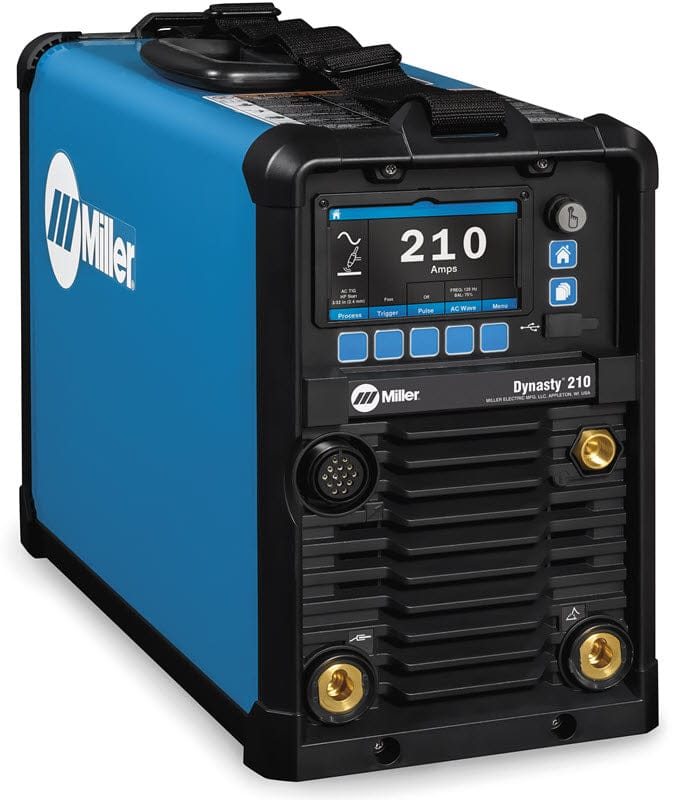
Miller Dynasty 210 — Best Overall for Serious Beginners
| Spec | Value |
|---|---|
| Process | AC/DC TIG, Stick |
| Amperage Range | 1-210A |
| Duty Cycle | 40% at 210A, 100% at 130A |
| Input Power | 120/240V Auto-Line (single and three-phase) |
| AC Frequency Control | 20-400 Hz |
| Pulse | Yes (0.1-5000 PPS) |
| Weight | 40 lbs |
| Warranty | 3 years |
| Price Range | $1,800-$2,100 |
According to Miller’s technical documentation, the Dynasty 210 uses Auto-Line power management that accepts any input from 120V to 480V, single or three-phase, without manual adjustment. This means the machine runs on a standard household outlet (with reduced output) or a full 240V shop circuit at rated capacity. Per Miller’s specs, the inverter-based design keeps weight to 40 lbs — roughly half the weight of older transformer-based TIG machines with similar output.
The AC frequency range of 20-400 Hz is the widest on this list. Miller’s documentation notes that frequencies above 150 Hz produce a tighter, more focused arc cone on aluminum, allowing greater precision on thin material. The pulse range (0.1-5000 PPS) provides fine control over heat input, which according to manufacturer data helps beginners manage the weld puddle on thin stock without burn-through.
The 100% duty cycle at 130A means the machine can run continuously at that output without overheating — more than adequate for the majority of home shop TIG work.
Best for: Beginners who are investing in a machine they will not outgrow. The Dynasty 210 covers every TIG application a home shop is likely to encounter, from thin aluminum sheet to heavy steel plate.
Limitation: At $1,800-$2,100, it is by far the most expensive machine on this list. The feature set exceeds what most first-time TIG welders will use in their first year. Beginners on a tighter budget can develop the same fundamental skills on a machine costing half as much.
Lincoln Electric Square Wave TIG 200 — Best Mid-Range Value
| Spec | Value |
|---|---|
| Process | AC/DC TIG, Stick |
| Amperage Range | 10-200A |
| Duty Cycle | 25% at 200A, 100% at 100A |
| Input Power | 120/230V dual voltage |
| AC Frequency Control | 20-200 Hz |
| Pulse | Yes (0.1-500 PPS) |
| Weight | 46 lbs |
| Warranty | 3 years |
| Price Range | $1,400-$1,600 |
Per Lincoln Electric’s specifications, the Square Wave TIG 200 is designed as a crossover machine for hobbyists and light fabrication. It features a simplified control panel with a single knob for amperage and clearly labeled AC balance and frequency controls. According to Lincoln’s documentation, the “Square Wave” AC output produces a crisper, more stable arc on aluminum compared to sine wave AC machines, with improved oxide cleaning efficiency.
The AC frequency range tops out at 200 Hz — lower than the Miller Dynasty 210 but adequate for the vast majority of aluminum work a home shop will encounter. Per Lincoln’s data sheet, the machine supports both high-frequency arc start (non-contact) and lift arc start, depending on the application. The stick welding capability at up to 200A provides a backup process for rough work and field repairs.
Lincoln rates the unit at 100% duty cycle at 100A on 230V, which covers most home shop TIG welding comfortably.
Best for: Beginners and intermediate welders who want AC/DC TIG capability from an established brand at a mid-range price. Lincoln’s dealer and service network is the largest in North America.
Limitation: At 46 lbs, it is the heaviest machine on this list. The 25% duty cycle at maximum output (200A) is the lowest here, though few home shop projects require sustained welding at 200A.
Everlast PowerTIG 200DV — Best AC/DC Value
| Spec | Value |
|---|---|
| Process | AC/DC TIG, Stick |
| Amperage Range | 10-200A |
| Duty Cycle | 60% at 200A |
| Input Power | 120/240V dual voltage |
| AC Frequency Control | 20-250 Hz |
| Pulse | Yes (0.1-500 PPS) |
| Weight | 45 lbs |
| Warranty | 5 years |
| Price Range | $900-$1,100 |
According to Everlast’s product documentation, the PowerTIG 200DV delivers AC/DC TIG welding with pulse at roughly half the price of the Miller Dynasty 210. The 60% duty cycle at full 200A output is the highest at max output on this list — a specification that matters for longer welds on thicker material where the machine runs near its ceiling.
Per Everlast’s specs, the unit includes AC frequency control up to 250 Hz, AC balance adjustment, and a digital display panel. The 5-year warranty is the longest on this list, exceeding both Miller and Lincoln by two years. Everlast manufactures inverter-based welding equipment and has built a reputation in the hobbyist and home shop segment as a value-focused alternative to the major brands.
The dual-voltage capability (120V/240V) provides flexibility for garage shops that may not have a dedicated 240V circuit initially.
Best for: Home shop welders who want full AC/DC TIG capability with pulse at a price point that does not require justifying a $1,500+ investment. The 5-year warranty provides additional risk mitigation.
Limitation: Everlast’s service and parts network is smaller than Miller’s or Lincoln’s. Per aggregated user feedback on third-party review sites, the control panel layout is less intuitive than Lincoln’s Square Wave TIG 200. The learning curve for navigating the digital menu system is steeper.
AHP AlphaTIG 203Xi — Best Budget AC/DC
| Spec | Value |
|---|---|
| Process | AC/DC TIG, Stick |
| Amperage Range | 10-200A |
| Duty Cycle | 60% at 200A |
| Input Power | 220V (240V compatible) |
| AC Frequency Control | 20-250 Hz |
| Pulse | Yes |
| Weight | 50 lbs |
| Warranty | 3 years |
| Price Range | $600-$750 |
Per AHP’s product specifications, the AlphaTIG 203Xi provides AC/DC TIG welding with pulse, AC frequency control, and AC balance adjustment at the lowest price point for a full-featured AC/DC machine on this list. AHP (America’s Hope Products) sells direct to consumer, which according to the manufacturer allows lower pricing by eliminating distributor margins.
The spec sheet shows a 60% duty cycle at 200A, matching the Everlast and exceeding the Lincoln and Miller at their maximum rated outputs. AC frequency control extends to 250 Hz. According to AHP’s documentation, the machine uses a MOSFET inverter design and includes a foot pedal for real-time amperage control — a critical accessory for TIG welding that some competitors sell separately.
The primary trade-off is input power: the AlphaTIG 203Xi requires 220V/240V input. There is no 120V option. Home shops without an existing 240V outlet will need to factor in electrical installation costs (typically $200-$500 depending on panel distance).
Best for: Budget-conscious beginners who have 240V available and want AC/DC TIG capability without spending over $800. The included foot pedal is a genuine value-add that competitors at this price point often omit.
Limitation: AHP is a smaller brand without brick-and-mortar dealer support. Warranty service is handled direct-to-manufacturer. At 50 lbs, it is the heaviest unit on this list. Some users report on third-party review platforms that build quality and component consistency can vary between production runs.
YesWelder TIG-205P AC/DC — Best Entry-Level
| Spec | Value |
|---|---|
| Process | AC/DC TIG, Stick |
| Amperage Range | 5-200A |
| Duty Cycle | 60% at 200A |
| Input Power | 110V/220V dual voltage |
| AC Frequency Control | 20-250 Hz |
| Pulse | Yes (0.5-500 PPS) |
| Weight | 26 lbs |
| Warranty | 2 years |
| Price Range | $300-$450 |
According to YesWelder’s specifications, the TIG-205P AC/DC packs AC/DC TIG welding with pulse, AC frequency control, and dual-voltage capability into a 26-lb package at the lowest price on this list. The dual-voltage design allows operation on a standard 110V household outlet (with reduced output) or a 220V circuit at full capacity.
Per YesWelder’s product data, the unit starts at 5A — the lowest minimum amperage here — which is a relevant specification for thin sheet metal work where heat control is critical. The pulse range extends to 500 PPS, and AC frequency control reaches 250 Hz. On paper, the feature set competes with machines costing three to four times as much.
At 26 lbs, the YesWelder TIG-205P is significantly lighter than every competitor on this list, making it practical to move between work areas or transport to job sites.
Best for: First-time TIG welders who want to learn AC/DC TIG welding without a significant financial commitment. At $300-$450, the cost of entry is low enough that the machine pays for itself if it replaces even one or two paid welding jobs.
Limitation: YesWelder is a newer brand without the established reliability track record or service infrastructure of Miller, Lincoln, or Everlast. The 2-year warranty is the shortest on this list. Per aggregated user feedback on third-party review platforms, quality control and long-term durability are the most common concerns. The specifications are impressive at the price point, but specification sheets do not capture arc quality, arc stability, or component longevity — areas where premium brands typically hold an advantage.
Full Comparison Table
| Spec | Miller Dynasty 210 | Lincoln Square Wave 200 | Everlast PowerTIG 200DV | AHP AlphaTIG 203Xi | YesWelder TIG-205P |
|---|---|---|---|---|---|
| Process | AC/DC TIG, Stick | AC/DC TIG, Stick | AC/DC TIG, Stick | AC/DC TIG, Stick | AC/DC TIG, Stick |
| Amperage Range | 1-210A | 10-200A | 10-200A | 10-200A | 5-200A |
| Duty Cycle | 40% @ 210A | 25% @ 200A | 60% @ 200A | 60% @ 200A | 60% @ 200A |
| Input Power | 120/240V Auto-Line | 120/230V | 120/240V | 220V only | 110V/220V |
| AC Frequency | 20-400 Hz | 20-200 Hz | 20-250 Hz | 20-250 Hz | 20-250 Hz |
| Pulse | 0.1-5000 PPS | 0.1-500 PPS | 0.1-500 PPS | Yes | 0.5-500 PPS |
| Weight | 40 lbs | 46 lbs | 45 lbs | 50 lbs | 26 lbs |
| Warranty | 3 yr | 3 yr | 5 yr | 3 yr | 2 yr |
| Price Range | $1,800-2,100 | $1,400-1,600 | $900-1,100 | $600-750 | $300-450 |
Essential Accessories for TIG Welding
TIG welding requires more supporting equipment than MIG welding. According to manufacturer setup guides and AWS recommendations, budget $200-$500 for these essentials beyond the welder itself:
- Argon shielding gas: 100% argon is used for both steel and aluminum TIG welding (unlike MIG, which uses a 75/25 argon/CO2 mix for steel). A standard 80 cu ft tank costs $200-$300 to purchase and $30-$50 to refill. Smaller 40 cu ft tanks are available for around $100-$150.
- Foot pedal or torch-mounted amperage control: A foot pedal provides real-time amperage adjustment while welding — essential for TIG work on varying thicknesses and joint configurations. Some machines include a foot pedal; others require purchasing one separately ($50-$150).
- Tungsten electrodes: 2% lanthanated (blue) tungsten is widely recommended for both AC and DC TIG welding. A pack of 10 costs $10-$20. Per AWS guidelines, electrode diameter should match the amperage range: 3/32” for 50-130A, 1/8” for 100-200A.
- Filler rod: ER70S-2 for mild steel, ER308L for stainless steel, ER4043 or ER5356 for aluminum. A 1 lb tube of 36” filler rods costs $10-$20.
- Auto-darkening welding helmet: TIG welding at low amperages requires a helmet with fast reaction time (1/20,000s or better) and shade range starting at shade 5 or lower. See the auto-darkening welding helmets guide for detailed comparisons.
Who This Is NOT For
TIG welding is not the right starting point for every welder, and AC/DC TIG machines are not the right investment for every project. Consider alternatives if:
-
Speed matters more than appearance. TIG welding is the slowest arc welding process. According to AWS data, MIG welding deposits filler metal 3-5 times faster than TIG on equivalent material thicknesses. For projects where weld appearance is secondary to production speed — trailer building, fence work, structural fabrication — a MIG welder for beginners is a more practical starting point.
-
The primary work is mild steel over 1/4” thick. TIG welding thick steel is possible but slow and impractical compared to MIG or stick. The heat input required for thick sections makes TIG tedious and inefficient. MIG or stick welding are standard processes for structural steel fabrication.
-
Budget is under $250 all-in. A TIG welder at any price requires argon gas, tungsten, filler rod, and a quality auto-darkening helmet. The total initial investment — including a budget TIG machine — realistically starts at $500-$600 minimum. If the total budget is under $250, a stick welder ($150-$200) is a more accessible entry point for learning arc welding fundamentals.
-
Outdoor or field welding is the primary use case. TIG welding requires still air — even a light breeze disperses the argon shielding gas and contaminates the weld. Per AWS guidelines, stick welding (SMAW) is the standard process for outdoor and field welding because it uses flux on the electrode to generate its own shielding, independent of wind conditions.
-
Welding cast iron or heavily rusted material. TIG welding requires clean base metal. Cast iron and heavily corroded steel are better suited to stick welding with appropriate electrodes (nickel rod for cast iron, 7018 for structural steel). The preparation time required to clean material for TIG welding often exceeds the time saved by the process.
-
Aluminum welding will never be needed. If the project list is exclusively steel and stainless, a DC-only TIG welder costs significantly less than an AC/DC unit and delivers identical performance on ferrous metals. Paying for AC capability that will never be used is an avoidable expense. Used DC TIG machines from Miller and Lincoln are widely available on the secondary market at $400-$800.
Sources
- Miller Dynasty 210 product specifications and Auto-Line technical documentation (millerwelds.com)
- Lincoln Electric Square Wave TIG 200 product data sheet and operator manual (lincolnelectric.com)
- Everlast PowerTIG 200DV specifications and user documentation (everlastwelders.com)
- AHP AlphaTIG 203Xi product specifications and documentation (ahpwelds.com)
- YesWelder TIG-205P AC/DC product specifications (yeswelder.com)
- American Welding Society (AWS) — GTAW process guidelines and safety standards
- AWS Welding Handbook, Volume 2: Welding Processes — GTAW chapter