Best Brad Nailers for Trim and Finish Work in 2026
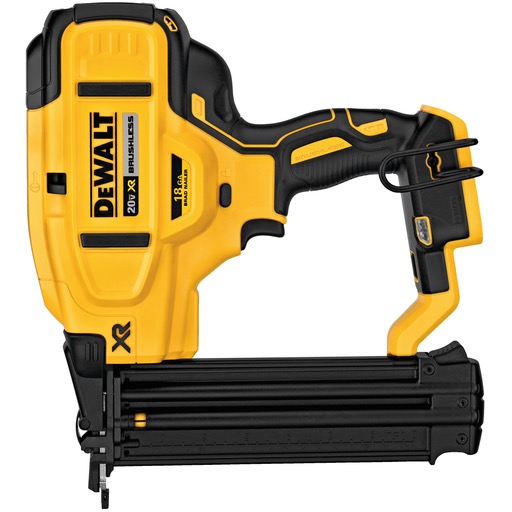
A brad nailer drives 18-gauge nails — thinner and shorter than the 16-gauge nails used in a finish nailer — for applications where hole size matters as much as fastening strength. Cabinet face frames, thin molding strips, window stops, craft trim, and light base shoe are the core use cases. For heavier structural trim (thick baseboard, door casing, stair treads), a finish nailer provides the holding power a brad nailer cannot match.
This guide covers four cordless 18-gauge brad nailers based on manufacturer specifications, explains the cordless vs. pneumatic decision, and clarifies when to use an 18-gauge brad nailer versus a 16-gauge finish nailer or a 23-gauge pin nailer.
Brad Nailer vs. Finish Nailer vs. Pin Nailer: Choosing Correctly
Three nail gauges cover 95% of interior trim and finish carpentry work. Understanding the distinctions prevents the two most common fastener mistakes: using a brad where a finish nail is required, and using an 18-gauge where a 23-gauge would leave a cleaner result.
| Gauge | Nail Diameter | Typical Length Range | Holding Strength | Primary Applications |
|---|---|---|---|---|
| 23-gauge (pin) | 0.025” | 1/2” – 1-3/8” | Lowest | Glue-up clamping, ultra-thin veneers, jig assembly, shop fixtures |
| 18-gauge (brad) | 0.0475” | 5/8” – 2-1/8” | Moderate | Cabinet face frames, thin molding, window stops, light trim |
| 16-gauge (finish) | 0.0625” | 1” – 2-1/2” | High | Door casing, baseboard, stair treads, crown molding |
| 15-gauge (angled finish) | 0.072” | 1-1/4” – 2-1/2” | Highest | Heavy baseboard, exterior trim, structural finish connections |
Per fastener industry data, a 23-gauge pin nail leaves a hole small enough to disappear under most finishes with no filler. The tradeoff is holding power — pins rely on glue for structural integrity and are not suitable for standalone fastening on any trim subject to racking, impact, or moisture cycling. The 18-gauge brad nail strikes the balance between hole size and holding power for the majority of interior cabinet and trim work. The 16-gauge finish nailer is the correct tool when fastener strength is as important as appearance.
The practical rule: Use a pin nailer for glue-assisted assemblies or veneers you cannot afford to mark. Use a brad nailer for most interior trim and cabinet work. Use a finish nailer for door casing, baseboards, and any trim where structural load is a consideration.
Cordless vs. Pneumatic Brad Nailers
Cordless brad nailers represent the majority of new purchases among professional trim crews, but pneumatic models remain relevant for specific workflows. The decision is not primarily about nail quality — both drive 18-gauge brads identically — but about compressor dependency, weight, and job-site conditions.
Cordless advantages:
- No compressor noise during interior finish work in occupied buildings
- No hose drag — critical for overhead crown molding and multi-story work
- No compressor warm-up or PSI management
- Battery shared with other platform tools when invested in a single ecosystem (see the DeWalt vs. Milwaukee vs. Makita battery platform comparison)
Pneumatic advantages:
- Lighter bare-tool weight — most pneumatic 18-gauge brad nailers weigh 2.0–3.0 lbs vs. 4.8–5.4 lbs for cordless
- Lower upfront cost — a quality pneumatic brad nailer runs $40–$80 vs. $120–$180 for cordless bare tool
- No battery management overhead — critical for large crews where charging discipline is inconsistent
- Consistent drive power from first to last nail without battery-charge variation
Third-party contractor surveys indicate that trim crews working in new construction — where air hoses are already run for other pneumatic tools — frequently retain pneumatic brad nailers for cost efficiency. Crews focused on occupied remodels and custom cabinetry installation increasingly favor cordless for the noise and mobility advantages. The same cordless-versus-pneumatic tradeoffs play out at the framing scale — see pneumatic vs cordless framing nailers.
Key Specifications Explained
Nail length range: Most 18-gauge brad nailers accept 5/8 inch to 2-1/8 inch nails. Verify the upper limit if long-nail applications (1-3/4 inch or longer into thick stock) are common. Some compact models top out at 2 inches.
Depth-of-drive adjustment: Tool-free depth adjustment dials allow setting nail counter-sink depth without a separate wrench. This matters when switching between materials — face-nailing 1/4-inch plywood back panels requires different depth settings than attaching 3/4-inch hardwood trim to a wall. Quality models offer micro-adjustable dials; budget models may use a coarser click-stop mechanism.
Magazine capacity: Ranges from 100 to 110 nails on the cordless models in this comparison. Higher capacity reduces reload interruptions during long production trim runs — relevant on commercial cabinet installation or continuous baseboard runs. On occasional-use jobs, capacity difference is not meaningful.
Actuation mode: Most cordless brad nailers are sequential-only — each nail requires a deliberate nose contact plus trigger pull. This prevents accidental double-nailing on finished surfaces. Pneumatic models sometimes offer a bump-fire mode option; for trim work, sequential mode is the appropriate setting regardless of which power source the nailer uses.
Dry-fire lockout: Stops the nailer from firing when the magazine is empty, preventing bare-striker marks on the work surface. Standard on professional models; sometimes omitted on budget tools.
No-mar tip: Rubber or plastic nose tip that contacts the workpiece before the nail drives, preventing dents and scuffs on finished surfaces. Replaceable when worn; confirm replacement tips are available for any model under consideration.
Top 18-Gauge Cordless Brad Nailers
DeWalt DCN680 — Best Overall
| Specification | Value |
|---|---|
| Battery Platform | 20V MAX |
| Nail Gauge | 18-gauge |
| Nail Length Range | 5/8” – 2-1/8” |
| Magazine Capacity | 110 nails |
| Shots Per Charge | Up to 1,100 (2.0 Ah) |
| Weight (bare tool) | 5.0 lbs |
| Depth Adjustment | Tool-free dial |
| Actuation Mode | Sequential |
| Dry-Fire Lockout | Yes |
| No-Mar Tip | Yes |
| Warranty | 3 years |
| Price Range | $130–$170 (bare tool) |
Per DeWalt’s specifications, the DCN680 uses a brushless motor with sequential actuation — each nail requires deliberate trigger pull and nose contact, preventing accidental double-nailing on finished trim. The 110-nail magazine capacity is among the highest in this comparison, reducing reload interruptions during production trim runs. DeWalt rates the tool at up to 1,100 nails per charge on a 2.0 Ah battery — a full day of light trim work on a single pack. At 5.0 lbs bare, the DCN680 sits in the middle of the weight range for cordless brad nailers.
The depth-of-drive dial is micro-adjustable with clear detents, which third-party reviewers at publications covering power tools have noted as one of the more precise mechanisms in the category — important when switching between soft pine molding and harder maple or cherry face frames.
Best for: DeWalt 20V MAX platform users who need a reliable all-day brad nailer for cabinet installation, light trim, and window casings. The high magazine capacity and long per-charge runtime reduce interruptions in production work.
Milwaukee 2746-20 M18 — Best for M18 Platform Crews
| Specification | Value |
|---|---|
| Battery Platform | M18 |
| Nail Gauge | 18-gauge |
| Nail Length Range | 5/8” – 2-1/8” |
| Magazine Capacity | 100 nails |
| Shots Per Charge | Up to 1,000 (2.0 Ah) |
| Weight (bare tool) | 5.4 lbs |
| Depth Adjustment | Tool-free dial |
| Actuation Mode | Sequential |
| Dry-Fire Lockout | Yes |
| No-Mar Tip | Yes |
| Warranty | 5 years |
| Price Range | $140–$180 (bare tool) |
Per Milwaukee’s specifications, the 2746-20 uses the M18 FUEL brushless motor system and delivers consistent drive power from the first nail to the last on a charge. The 5-year tool warranty is the longest in this comparison — Milwaukee’s commercial-grade coverage versus the 3-year terms from competing brands. At 5.4 lbs, it is the heaviest model here, which is a noticeable difference for extended overhead crown molding installation. Milwaukee rates the nailer at 1,000 shots per 2.0 Ah charge; with the M18 HD 9.0 Ah or higher-capacity packs, that figure scales proportionally. The dry-fire lockout and sequential trigger prevent surface damage and double-drives.
Best for: Contractors already invested in the M18 platform who want a brad nailer that shares batteries with their existing tool lineup. The 5-year warranty is the strongest coverage available in this category.
Makita XNB01Z — Best for Extended Overhead Work
| Specification | Value |
|---|---|
| Battery Platform | 18V LXT |
| Nail Gauge | 18-gauge |
| Nail Length Range | 5/8” – 2” |
| Magazine Capacity | 100 nails |
| Shots Per Charge | Up to 1,300 (3.0 Ah) |
| Weight (bare tool) | 4.8 lbs |
| Depth Adjustment | Tool-free dial |
| Actuation Mode | Sequential |
| Dry-Fire Lockout | Yes |
| No-Mar Tip | Yes |
| Warranty | 3 years |
| Price Range | $120–$160 (bare tool) |
Per Makita’s specifications, the XNB01Z is the lightest model in this comparison at 4.8 lbs and delivers the highest shots-per-charge rating (1,300 on a 3.0 Ah LXT battery). The lighter weight and higher runtime make it the strongest choice for extended overhead trim work — ceiling molding, upper cabinet face frames, and crown applications where arm fatigue accumulates over a full day. Makita’s maximum nail length tops out at 2 inches rather than 2-1/8 inches, which covers the vast majority of brad nail applications; this is only a limitation if 2-1/8-inch nails are regularly required for thicker stock.
Best for: Finish carpenters and cabinet installers who spend significant time on overhead work. The weight-to-runtime ratio is the best in this comparison.
Ryobi PCL310B1 — Best Budget Option
| Specification | Value |
|---|---|
| Battery Platform | PCL (18V ONE+) |
| Nail Gauge | 18-gauge |
| Nail Length Range | 5/8” – 2” |
| Magazine Capacity | 105 nails |
| Shots Per Charge | Up to 700 (1.5 Ah) |
| Weight (bare tool) | 5.3 lbs |
| Depth Adjustment | Tool-free dial |
| Actuation Mode | Sequential |
| Dry-Fire Lockout | Yes |
| No-Mar Tip | Yes |
| Warranty | 3 years |
| Price Range | $70–$100 (bare tool) |
Per Ryobi’s specifications, the PCL310B1 uses the 18V ONE+ platform — one of the largest battery ecosystems by tool count in the consumer and prosumer space. At $70–$100 for the bare tool, it undercuts professional models by $50–$80 while offering comparable nail range and magazine capacity. The 700-shot-per-charge rating is the lowest in this comparison, and Ryobi’s brushed motor has lower runtime efficiency than the brushless motors in the DeWalt, Milwaukee, and Makita alternatives.
Best for: Homeowners, occasional remodelers, and trim hobbyists who need a brad nailer for periodic projects. The low bare-tool price and ONE+ compatibility make it the most accessible entry point in the category.
Limitation: The brushed motor reduces runtime compared to brushless competitors. For a trim crew installing 500+ linear feet of molding per day, the brushless models above provide more reliable all-day performance.
Full Comparison
| Model | Platform | Nail Range | Shots/Charge | Weight | Actuation | Warranty | Price |
|---|---|---|---|---|---|---|---|
| DeWalt DCN680 | 20V MAX | 5/8”–2-1/8” | 1,100 | 5.0 lbs | Sequential | 3 years | $130–$170 |
| Milwaukee 2746-20 | M18 | 5/8”–2-1/8” | 1,000 | 5.4 lbs | Sequential | 5 years | $140–$180 |
| Makita XNB01Z | 18V LXT | 5/8”–2” | 1,300 | 4.8 lbs | Sequential | 3 years | $120–$160 |
| Ryobi PCL310B1 | 18V ONE+ | 5/8”–2” | 700 | 5.3 lbs | Sequential | 3 years | $70–$100 |
Who This Is NOT For
Per fastener industry standards and contractor usage data, an 18-gauge brad nailer is the wrong tool in these situations:
- Heavy baseboard and door casing. 3/4-inch thick hardwood baseboard and solid wood door casing require 16-gauge finish nails for adequate holding power — particularly in high-traffic areas where racking loads are common. A brad nailer is adequate only when supplemented with adhesive or when the substrate allows reliable glue bonding.
- Structural connections. Any connection subject to shear or withdrawal load — stair treads, newel posts, structural blocking — requires 15- or 16-gauge nails minimum. Brad nails are trim fasteners, not structural fasteners.
- Exterior trim. Moisture cycling and UV exposure accelerate fastener failure in 18-gauge nails. Stainless steel 16-gauge finish nails or stainless brad nails are required for exterior trim applications where rust staining is unacceptable. Verify nail material before specifying for exterior work.
- Users who need an invisible hole. When the finish appearance requires zero visible hole — tight-grained exotic woods, high-gloss lacquer finishes, or veneer applied over a glued substrate — a 23-gauge pin nailer leaves a smaller mark than any 18-gauge brad. The tradeoff is that pins provide negligible holding strength without adhesive backup.
- Anyone without a finish nailer for heavier trim. A brad nailer is a complement to a finish nailer, not a replacement. A truck or shop with only a brad nailer will regularly encounter applications — door casing, thick baseboard, cap rail — where the tool is inadequate. Budget for both tools if working across the full range of interior trim.
- High-volume new construction framing crews. If the job involves anything from dimensional lumber to structural sheathing, the correct tool is a cordless framing nailer, not a brad nailer. Brad nailers are finish tools for the last stage of a project.
What You’ll Also Need
- 18-gauge brad nails — 1-1/4 inch, galvanized — The most common length for baseboard and interior trim attachment to drywall over studs. Galvanized coating prevents rust staining in humid environments. Check price on Amazon →
- 18-gauge brad nails — 5/8 inch — For face-nailing thin molding strips, cabinet back panels, and decorative trim under 1/2-inch thickness. Check price on Amazon →
- Brad nailer no-mar tip replacement — The rubber no-mar tip scuffs and flattens over time, eventually marring finished surfaces. A replacement tip prevents workpiece damage on stained or painted trim. Check price on Amazon →
- Nail set punch — 1/32-inch tip — For hand-setting any brad nails that don’t fully countersink, without marring adjacent surfaces. Check price on Amazon →
Related Guides
- Best Finish Nailers for Contractors — 16-gauge for heavier trim, baseboards, and door casing
- Best Cordless Framing Nailers — 30/21-degree for structural framing and sheathing
- Best Miter Saws for Contractors — precision crosscuts for trim and casing
- DeWalt vs. Milwaukee vs. Makita Battery Platform Comparison — choosing the right ecosystem before committing to a cordless nailer
Sources
- DeWalt DCN680 product specifications and documentation (dewalt.com)
- Milwaukee 2746-20 M18 brad nailer product documentation (milwaukeetool.com)
- Makita XNB01Z product specifications (makitatools.com)
- Ryobi PCL310B1 product documentation (ryobitools.com)
- Fastener Technical Institute — nail gauge and holding strength data
- ANSI/ISEA 105 — Hand Protection standard